USAID DEC
Community and Government Unity Deliver Unprecedented Benefits
Community and Government Unity Deliver Unprecedented Benefits Cooperation between local government and community in Kajaki District, Hilmand Province, Afghanistan, has yielded fresh optimism.
2014 · 1 pages
Sign in to readA free account is required to download.
Abstract
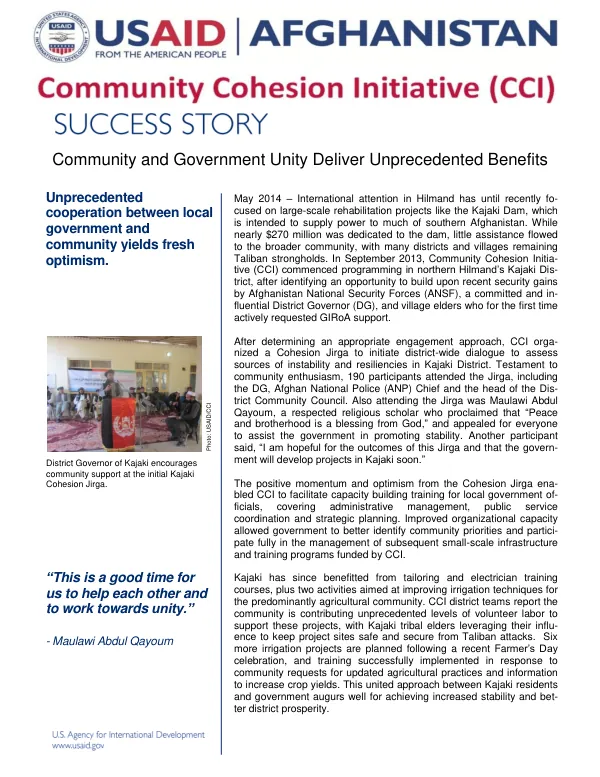
Maulawi Abdul Qayoum, District Governor of Kajaki, emphasizes the importance of unity, stating, "This is a good time for us to help each other and to work towards unity." The District Governor encourages community support at the initial Kajaki Cohesion Jirga. In May 2014, international attention in Hilmand Province focused on large-scale rehabilitation projects, such as the Kajaki Dam, which is intended to supply power to much of southern Afghanistan. However, little assistance flowed to the broader community, with many districts and villages remaining Taliban strongholds. In September 2013, the Community Cohesion Initiative (CCI) commenced programming in northern Hilmand's Kajaki District, building upon recent security gains by the Afghanistan National Security Forces (ANSF), a committed and influential District Governor, and village elders who actively requested GIRoA support. A Cohesion Jirga was organized to initiate district-wide dialogue to assess sources of instability and resiliencies in Kajaki District. The Jirga, attended by 190 participants, including the District Governor, Afghan National Police (ANP) Chief, and the head of the District Community Council, demonstrated community enthusiasm. Maulawi Abdul Qayoum, a respected religious scholar, proclaimed that "Peace and brotherhood is a blessing from God," and appealed for everyone to assist the government in promoting stability. Another participant expressed hope for the outcomes of the Jirga and the government's development of projects in Kajaki. The positive momentum and optimism from the Cohesion Jirga enabled CCI to facilitate capacity building training for local government officials, covering administrative management, public service coordination, and strategic planning. Improved organizational capacity allowed the government to better identify community priorities and participate fully in the management of subsequent small-scale infrastructure and training programs funded by CCI. Kajaki has since benefited from tailoring and electrician training courses, as well as two activities aimed at improving irrigation techniques for the predominantly agricultural community. The community is contributing unprecedented levels of volunteer labor to support these projects, with Kajaki tribal elders leveraging their influence to keep project sites safe and secure from Taliban attacks. Six more irrigation projects are planned following a recent Farmer's Day celebration, and training has been successfully implemented in response to community requests for updated agricultural practices and information to increase crop yields. This united approach between Kajaki residents and government augurs well for achieving increased stability and better district prosperity.