USAID
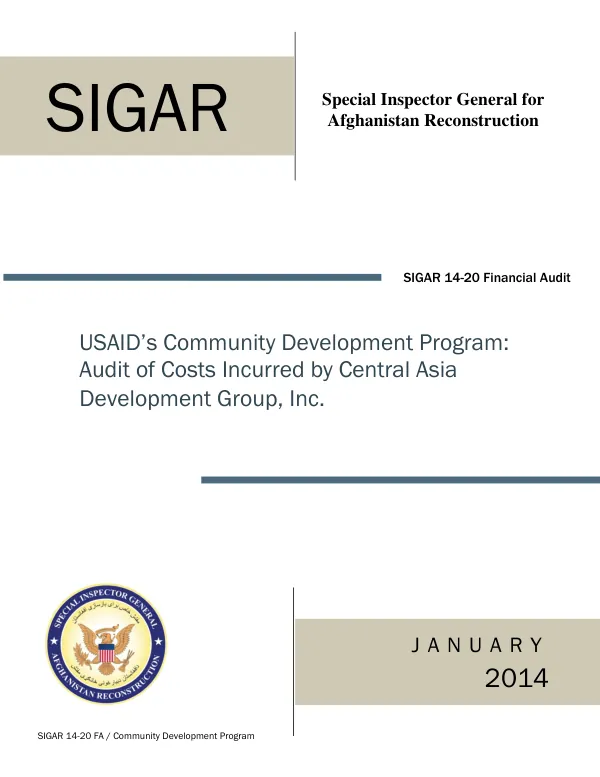
SIGAR 14-20 Financial Audit: USAID’s Community Development Program
The Community Development Program in Afghanistan was a USAID-funded initiative aimed at providing temporary employment and income through Cash-for-Work programs to targeted individuals and communities in 16 vulnerable Afghan populations.
2014 · 93 pages
Sign in to readA free account is required to download.
Abstract
The program, formerly known as the Food Insecurity Response for Urban Populations, was designed to reduce the impact of poverty and economic vulnerability that could result in instability and insurgency. The program served both rural and urban areas, with a focus on five provinces: Kandahar, Lashkar Gah, Tarin Kot, Gardez, and Jalalabad. The program's objectives were to provide temporary employment and income to targeted individuals and communities, with the intended effects of reducing poverty and economic vulnerability. The program was implemented through a series of modifications to the original agreement, which increased the total amount of the agreement from $10 million to $265.9 million. The program's scope was expanded to include nine new provinces in September 2009, and two new provinces were added in August 2010. A financial audit of costs incurred by Central Asia Development Group, Inc. (CADG) under the cooperative agreement was conducted by Mayer Hoffman McCann P.C. from March 12, 2009, through June 30, 2013. The audit covered $254.5 million in expenditures and was performed in accordance with generally accepted government auditing standards. The audit found that CADG's Fund Accountability Statement presented fairly, in all material respects, revenues received and costs incurred under the cooperative agreement, except for $7.8 million in questioned costs and $9,613 in lost interest earnings. The questioned costs included $563,477 in ineligible costs and $7.2 million in unsupported costs. The audit identified nine internal control findings and five instances of noncompliance, which prompted the auditors to question $7.8 million in costs. The audit also found that CADG had not deposited advances of Federal funds into an interest-bearing account as required, resulting in an estimated lost program income of $9,613. The audit recommended that the Mission Director of USAID/Afghanistan determine the allowability of and recover, as appropriate, $7.8 million in questioned costs and $9,613 in lost interest revenue. The audit also recommended that CADG address the nine internal control findings and five compliance findings identified in the report. The Office of Special Inspector General for Afghanistan Reconstruction (SIGAR) will follow up with the agency to obtain information on the corrective actions taken in response to the recommendations. The Community Development Program was a critical component of USAID's efforts to support economic development and stability in Afghanistan. The program's objectives were to provide temporary employment and income to targeted individuals and communities, with the intended effects of reducing poverty and economic vulnerability. The program's implementation was complex, with a series of modifications to the original agreement and a focus on multiple provinces. The financial audit of costs incurred by CADG under the cooperative agreement identified several issues, including questioned costs and internal control weaknesses, which must be addressed to ensure the program's effectiveness and accountability.