USAID DEC
Community-Based Natural Resource Management (CBNRM) and Empowerment and Rural Democracy
Sign inUSAID
Community-Based Natural Resource Management (CBNRM) and Empowerment and Rural Democracy
Community-based natural resource management (CBNRM) is a strategy aimed at creating the right incentives and conditions for resource users to manage natural resources sustainably.
2013 · 4 pages
Sign in to readA free account is required to download.
Abstract
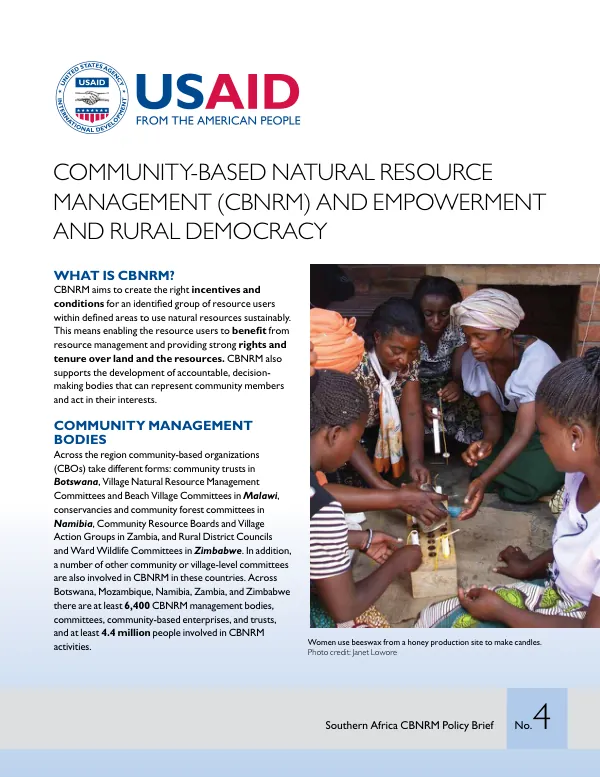
This approach enables resource users to benefit from resource management and provides them with strong rights and tenure over land and resources. CBNRM also supports the development of accountable, decision-making bodies that can represent community members and act in their interests. Across Southern Africa, community-based organizations (CBOs) take various forms, including community trusts in Botswana, Village Natural Resource Management Committees and Beach Village Committees in Malawi, conservancies and community forest committees in Namibia, Community Resource Boards and Village Action Groups in Zambia, and Rural District Councils and Ward Wildlife Committees in Zimbabwe. These organizations are involved in CBNRM activities, with at least 6,400 CBNRM management bodies, committees, community-based enterprises, and trusts, and at least 4.4 million people participating in CBNRM activities across Botswana, Mozambique, Namibia, Zambia, and Zimbabwe. CBNRM provides opportunities for decentralization, empowering local communities through the restoration of their rights and responsibilities over natural resources. This approach contributes significantly to women's empowerment by providing opportunities for them to assume leadership positions within the community. In Zimbabwe, women have higher rates of involvement in leadership in Wards and CBOs, and have increased their participation in community-based enterprises. In Namibia, 33 percent of conservancy management committees' membership was female, with four female chairpersons and 33 out of 66 conservancies having women running conservancy finances. CBNRM promotes rural democracy through devolved natural resources usage rights to community institutions, devolved decision-making, improved advocacy, and institutional development. However, CBOs must be representative and accountable, and implement good governance, particularly when the income affected involves large numbers of people. Evidence from around the region shows that CBOs can manage their finances well if given appropriate assistance. Governments and other support agencies should help CBOs develop mechanisms that promote good governance, such as proper accounting procedures and transparent reporting of financial statements to community members. Empowerment has been achieved through providing communities with secure rights over land and resources through legislation, enabling communities to retain the income from sustainable resource use, supporting the development of accountable community institutions, and providing appropriate training and skills development. Key elements in CBO good governance include holding regular elections for CBO management committees, developing constitutions through strong community participation, enabling community members to develop checks and balances on the powers of the CBO committee, holding annual general meetings, ensuring approval of budgets by community members, and opening separate bank accounts for operational costs and community benefits.