USAID
Community-Based Surveillance During the COVID-19 Pandemic
Community-based surveillance (CBS) is a method used for early detection of potentially epidemic diseases through reporting by community members.
2021 · 3 pages
Sign in to readA free account is required to download.
Abstract
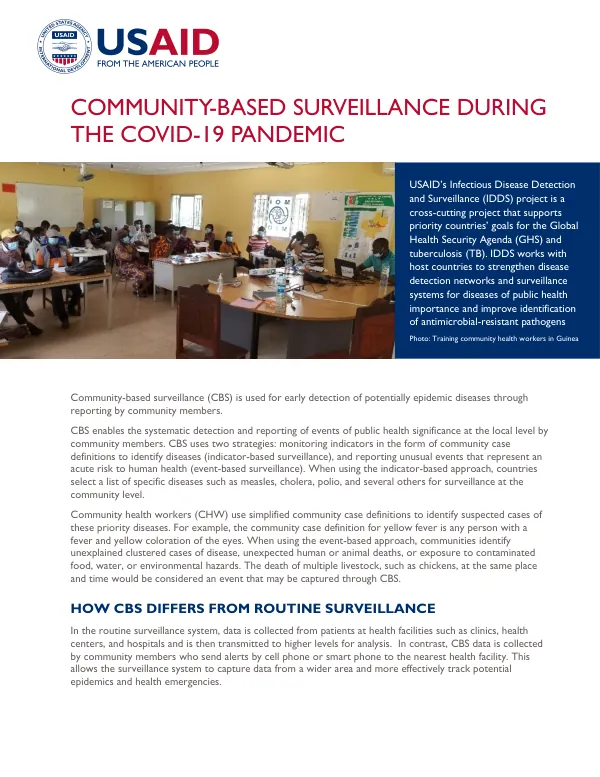
This approach enables the systematic detection and reporting of events of public health significance at the local level by community members. CBS employs two strategies: monitoring indicators in the form of community case definitions to identify diseases, and reporting unusual events that represent an acute risk to human health. The indicator-based approach involves countries selecting a list of specific diseases, such as measles, cholera, and polio, for surveillance at the community level. Community health workers (CHW) use simplified community case definitions to identify suspected cases of these priority diseases. For example, the community case definition for yellow fever is any person with a fever and yellow coloration of the eyes. The event-based approach involves communities identifying unexplained clustered cases of disease, unexpected human or animal deaths, or exposure to contaminated food, water, or environmental hazards. In contrast to routine surveillance, which collects data from patients at health facilities and transmits it to higher levels for analysis, CBS data is collected by community members who send alerts by cell phone or smart phone to the nearest health facility. This allows the surveillance system to capture data from a wider area and more effectively track potential epidemics and health emergencies. The USAID Infectious Disease Detection and Surveillance (IDDS) project supports priority countries' goals for the Global Health Security Agenda (GHS) and tuberculosis (TB). IDDS works with host countries to strengthen disease detection networks and surveillance systems for diseases of public health importance and improve identification of antimicrobial-resistant pathogens. IDDS has supported the implementation of CBS in Senegal, Guinea, and Mali, and has provided technical and operational support for integrating COVID-19 reporting into CBS activities. To assist countries in responding to the COVID-19 pandemic, IDDS provided support for integrating COVID-19 reporting into CBS activities, including incorporating COVID-19 contact tracing into the smart-phone based system used for CBS in Senegal, and updating CBS training materials for CHW to incorporate COVID-19 information. IDDS trained 84 health workers in Guinea and 72 CHW in Mali during pilots of their new training materials to ensure COVID-19 cases could be captured in the new system. Several critical best practices were identified through the activities supported by IDDS to integrate COVID-19 into existing CBS systems. Rapidly updating CBS training materials to incorporate COVID-19 was a critical step for rolling out improved guidance for responding to the pandemic at the community level. Ensuring that CHW are included in training opportunities to detect and appropriately respond to disease outbreaks ensures that outbreaks can be identified at the community level. Once training materials are updated, it is critical to have both in-person and virtual options for training CHWs to lower the risk of COVID-19 spread. When assessing the impact of CBS in COVID-19 reporting, data must be able to trace back which cases were initially flagged by a CHW rather than from a patient arriving at a facility. Due to data management processes in some of the IDDS-supported countries, this was not always feasible. However, if a code for the origin of cases is incorporated into data reporting, health authorities can track the number of cases first detected by communities versus those first detected at health facilities. Quarantine restrictions in Senegal prevented health authorities from making visits to verify CBS alerts for several months, highlighting the need for adequate safety measures, such as masks, gloves, and hand sanitizer, to increase the effectiveness of CBS.
Related documents