INTERNATIONAL BUSINESS AND TECHNICAL CONSULTANTS, INC.
Community Generated Indicators Training Toolkit
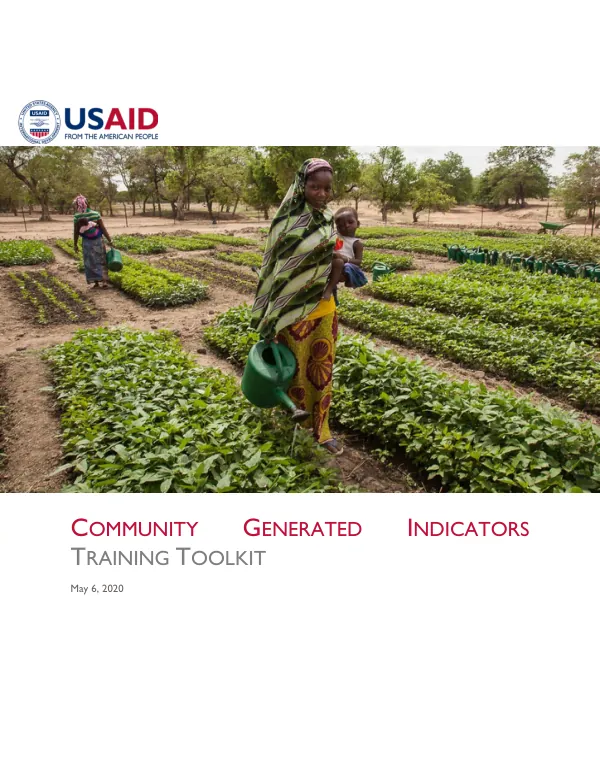
The Community Generated Indicators (CGI) approach emphasizes locally derived, context-specific signs of peace and violent extremism (VE) that pertain to numerous aspects of daily life in conflict/post-conflict communities.
2020 · 77 pages
Sign in to readA free account is required to download.
Abstract
This approach engages communities to develop their own, nuanced indicators that are grounded in the particular situations, feelings, and cultural contexts of various localities. The CGI methodology involves conducting focus group discussions (FGDs) with community members, where the group is asked about indicators of peace and VE. The CGI methodology was first applied in a region of West Africa known as Liptako-Gourma, a porous, tri-state region encompassing parts of Mali, Niger, and Burkina Faso. The region has witnessed substantial instability in the wake of the 2012 Tuareg Rebellion in northern Mali, and the spread of violent extremist organizations' (VEOs) influence and activity. The fallout from these events has resulted in the mass displacement of people, organized criminal activity, and mounting extremist threats throughout Liptako-Gourma. To contribute to the body of knowledge on this topic, the Peace through Evaluation, Learning and Adapting (PELA) activity collected, evaluated, and delivered data on what the communities living in Liptako-Gourma view as indicators of peace and VE in their daily lives. The PELA activity drew on participatory methodological approaches to derive the CGI approach, which engages communities to develop their own, nuanced indicators that are grounded in the particular situations, feelings, and cultural contexts of various localities. The CGI methodology involves several key steps, including data collection site selection, organization of FGDs, quality control and development of longlists, verification workshops, and data coding and analysis. The methodology also emphasizes the importance of recruiting a research team that is representative of the community being studied, and providing training to the research team on the CGI methodology. The training toolkit developed by the PELA activity includes instructions on how to conduct the data collection training, as well as the training tools used to train the research teams in Burkina Faso and Niger for the original CGI studies. The toolkit is designed to be used by other actors to carry out the CGI methodology, and includes information on how to recruit the training facilitators and research team, conduct the research team training, and analyze the data. The CGI approach has several key benefits, including the ability to capture sub-state, community-based processes and thereby more accurately represent the everyday lived experiences of communities facing VE. Including such bottom-up indicators with existing top-down indicators helps researchers refine the measurement of peace and VE, which in turn informs more valid and precise programming and policy responses. The PELA activity has developed a training toolkit and conducted training-of-trainers workshops in Mali, Niger, and Burkina Faso to support the implementation of the CGI methodology. The toolkit includes instructions on how to conduct the data collection training, as well as the training tools used to train the research teams in Burkina Faso and Niger for the original CGI studies. The PELA activity has also developed a set of indicators that can be used to measure peace and VE in communities, and has provided training to researchers and practitioners on how to use these indicators. The CGI methodology has been applied in several countries, including Mali, Niger, and Burkina Faso. The methodology has been used to collect data on what communities view as indicators of peace and VE in their daily lives, and has provided insights into the complex and nuanced nature of peace and VE in these communities. The CGI approach has been shown to be a valuable tool for understanding the everyday lived experiences of communities facing VE, and has the potential to inform more effective programming and policy responses to these challenges. The PELA activity has also developed a set of guidelines for the use of the CGI methodology, including information on how to select data collection sites, organize FGDs, and analyze the data. The guidelines also provide information on how to recruit and train research teams, and how to ensure the quality and validity of the data collected. Overall, the CGI approach has the potential to provide a more nuanced and accurate understanding of peace and VE in communities, and to inform more effective programming and policy responses to these challenges. The PELA activity has developed a training toolkit and conducted training-of-trainers workshops to support the implementation of the CGI methodology, and has provided training to researchers and practitioners on how to use the CGI approach.
Related documents