USAID DEC
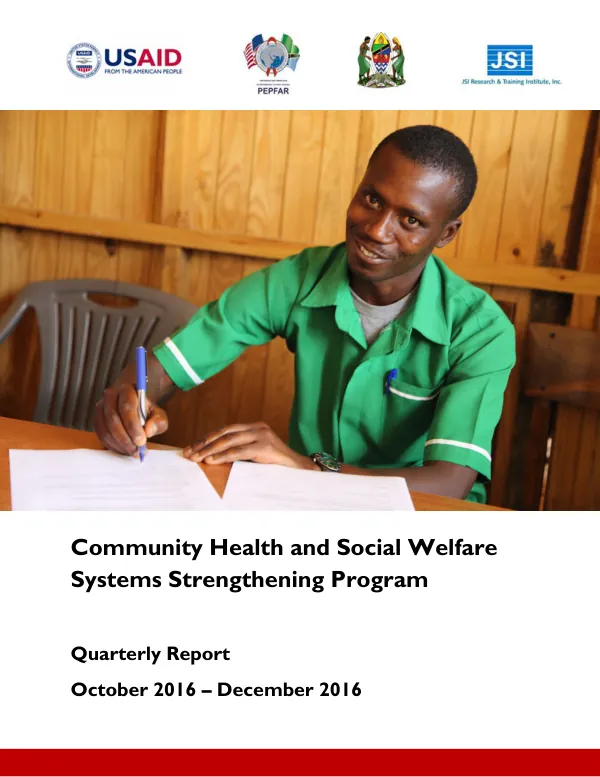
Community Health and Social Welfare Systems Strengthening Program (CHSSP) PY3 QR 1 Report
Sign inJSI RESEARCH & TRAINING INSTITUTE, INC
Community Health and Social Welfare Systems Strengthening Program (CHSSP) PY3 QR 1 Report
The Community Health and Social Welfare Systems Strengthening Program (CHSSP) is a program aimed at supporting the government of Tanzania in controlling the HIV epidemic.
2016 · 33 pages
Sign in to readA free account is required to download.
Abstract
In program year two, CHSSP aligned with PEPFAR 3.0 to achieve the UNAIDS global 90-90-90 goal by 2020. This goal includes diagnosing 90% of people with HIV, providing 90% of those diagnosed with antiretroviral therapy (ART), and achieving viral suppression in 90% of people on ART. CHSSP supports establishing and sustaining an enabling environment in which communities contribute to policies and decision-making, expand and support human resources for community health and social welfare services, and strengthen the system and structures in place to achieve the PEPFAR 3.0 goals. In the current quarter, CHSSP continued its efforts to sustain responsive and effective community systems and structures for epidemic control. One of the key highlights of the quarter was CHSSP's collaboration with the Department of Social Welfare (DSW) in gathering and incorporating comments from stakeholders as part of the process for revising the Most Vulnerable Children (MVC) identification guidelines. The first draft of the revised guideline will be shared with the DSW Task Force in the next quarter, and once finalized, it will be used to identify and refer MVC to critical services. CHSSP also finalized the National Integrated Case Management System (NICMS) framework, which will standardize service provision of integrated, HIV-sensitive social welfare services in Tanzania for the first time. Additionally, CHSSP met all case management training targets for the quarter and designed and developed an HIV-sensitive community case worker (CCW) training module. This module was used to train 111 district master trainers, who will cascade case management training to CCWs. To support the implementation of the NICMS, CHSSP led the process to disseminate guidelines for CCW recruitment in seven PEPFAR priority scale-up councils. CHSSP also assisted health management teams in six PEPFAR scale-up councils with ongoing identification and recruitment of 765 lead case workers and 137 lead case worker supervisors. Providing case management training to CCWs, lead case workers, and lead case worker supervisors directly supports Tanzania's health and social protection goals and contributes to HIV epidemic control. CHSSP advanced the finalization of the country's pioneer community-based health program (CBHP) design document by clarifying roles and responsibilities of relevant actors and institutions. This document is a critical piece of the CBHP and will ensure the proper identification, recruitment, training, and deployment of community health workers (CHWs). CHSSP also scaled up the HIV counseling and testing (HTC) improvement collaborative model to two additional councils, using results from implementing the model to inform the scaling-up process. In collaboration with TACAIDS, CHSSP conducted a series of training sessions for health management teams and district master trainers on the NICMS framework and CCW training module. These training sessions aimed to build the capacity of health management teams and district master trainers to implement the NICMS and provide case management services to MVC and other key populations. Overall, CHSSP's efforts in the current quarter have contributed to the strengthening of community systems and structures for epidemic control in Tanzania. The program's focus on case management training, NICMS implementation, and CBHP design will help to improve the health and social protection outcomes of MVC and other key populations, ultimately contributing to the achievement of the UNAIDS 90-90-90 goal by 2020.