USAID DEC
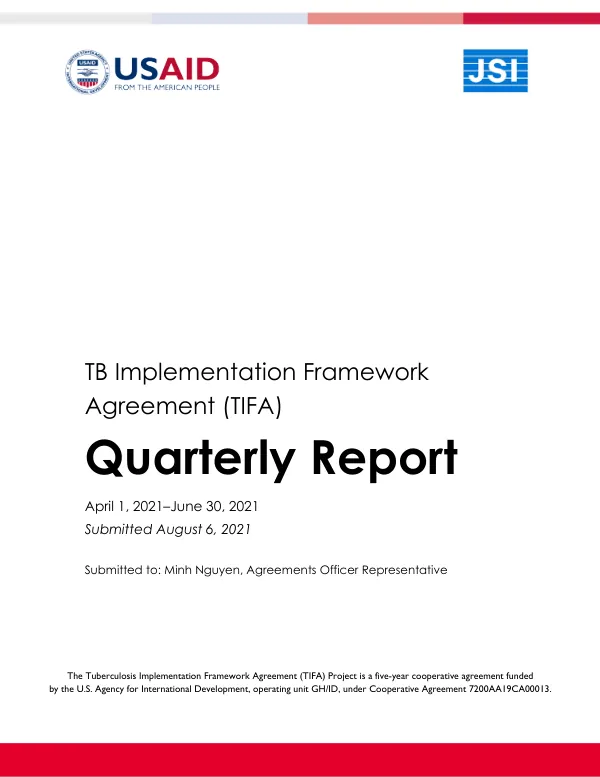
TB Implementation Framework Agreement (TIFA) Quarterly Report January 1, 2021–March 31, 2021
Sign inJSI RESEARCH & TRAINING INSTITUTE, INC
TB Implementation Framework Agreement (TIFA) Quarterly Report January 1, 2021–March 31, 2021
The Tuberculosis Implementation Framework Agreement (TIFA) Project is a five-year cooperative agreement funded by the U.S.
2021 · 21 pages
Sign in to readA free account is required to download.
Abstract
Agency for International Development, operating unit GH/ID, under Cooperative Agreement 7200AA19CA00013. The project aims to accelerate countries' progress toward national and global TB targets through direct engagement with local governments and partners. TIFA codesigns TB commitment grants that support the National TB Programs (NTPs) and other local organizations in developing countries. Key activities during the quarter included presenting an analysis of TIFA performance to-date to the new AOR team and providing an overview of TIFA to USAID/Washington TB advisors. TIFA worked with 11 missions and 10 NTPs, signing three Tuberculosis Commitment Grants (TCGs) in Bangladesh, Democratic Republic of Congo, and Zimbabwe. Nine TCGs are anticipated early in quarter 3. TIFA monitored 11 active TCGs and provided routine and on-demand support to grantees and USAID missions. Challenges faced by TIFA during the quarter included improving the efficiency of TCG co-design, addressing late submissions of milestones by grantees, and mitigating the impact of COVID-19 on TCG activities. TIFA conducted a process analysis to identify areas for improvement and implemented changes to expedite the co-design process. These changes included adjusting co-design and communication for each NTP based on needs and preferred pace, combining activity planning and budget sessions, and providing responsive review and feedback. TIFA also conducted an analysis of the milestone review and approval process, finding that the technical review of milestones took the most time to complete, averaging 15 days. TIFA updated the Domestic Resource Mobilization Checklist to reflect and incorporate sustainability principles that go beyond financial sustainability. The sustainability checklist is designed to provide contextualized opportunities that meet the countries where they are. The project is on track to sign TCGs in Pakistan, the Philippines, Malawi, Uzbekistan, and Vietnam early in quarter 3. TIFA will also continue working with the Democratic Republic of Congo (DRC), Ethiopia, India, and Tanzania as they develop their TCG concepts. TIFA plans to present the revised Sustainability Checklist to USAID for review and feedback in early May and finalize the tool soon after. TIFA's cross-cutting activities during the quarter included the TCG process and tools, TB Commitment Grant Toolkit, and co-design process. The TIFA team conducted an internal analysis of the co-design process, focusing on the length of time it took to develop TCGs. The results showed that, on average, it took approximately 120 days for USAID Missions and NTPs to agree on TCG activities and draft the concept note for the first round. The co-design process itself took on average approximately 100 days, and the TCG approval process took another 20 days. TIFA believes that the result speaks to the learning curve of the first round and that the design process will move much more quickly in successive rounds of funding. An analysis of the timelines for NTPs and missions developing their second and third rounds of TCGs revealed a decrease of 78% in the amount of time taken, going from 241 days in round 1 to 54 days in round 2. The project's geographic focus includes countries in Africa, Asia, and Eastern Europe, with a focus on supporting the NTPs and other local organizations in developing countries. The project's timeframes include the period from January 1, 2021, to March 31, 2021, with a focus on implementing TCGs and providing support to grantees and USAID missions.