GOVERNMENT OF INDONESIA
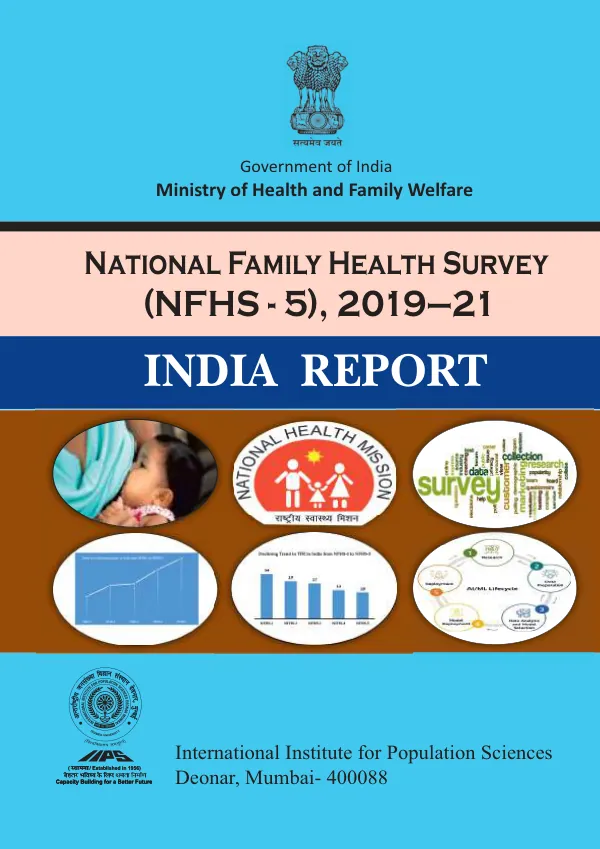
National Family Health Survey (NFHS-5), 2019-21: India
The National Family Health Survey (NFHS-5) in India was conducted between 2019 and 2021.
2021 · 715 pages
Sign in to readA free account is required to download.
Abstract
The survey aimed to provide information on various health and family welfare indicators, including fertility, family planning, and maternal and child health. The survey was conducted by the International Institute for Population Sciences (IIPS) in collaboration with the Ministry of Health and Family Welfare, Government of India. The survey objectives included assessing the levels and trends of fertility, family planning, and maternal and child health indicators, as well as evaluating the impact of various health and family welfare programs. The survey used a multi-stage sampling design, with a sample of 6,37,764 households and 6,24,224 women in the reproductive age group (15-49 years). The survey collected data on various health and family welfare indicators, including drinking water sources and treatment, sanitation, exposure to smoke inside the home, household wealth, hand washing, household population and composition, birth registration, death registration, children's living arrangements and parental survival, schooling, disability, use of tobacco and alcohol, and possession of mosquito nets. The survey also collected data on the characteristics of respondents, including basic characteristics, schooling and literacy, mass media exposure, employment, and occupation. The survey found that the majority of respondents had completed primary education, and a significant proportion of women had never attended school. The fertility and fertility preferences chapter of the survey reported that the total fertility rate (TFR) in India was 2.3 children per woman, with a decline of 0.4 children per woman since the previous survey. The survey also found that the proportion of women who had ever given birth was 54.6%, and the mean number of children ever born was 2.4. The survey reported that the majority of women used modern contraceptive methods, with a prevalence of 54.8%. The survey also found that the unmet need for family planning was 12.6%, and the unmet need for spacing was 8.5%. The survey recommended that the government should focus on increasing access to family planning services, particularly in rural areas, and improving the quality of services. The survey also reported that the maternal mortality ratio (MMR) in India was 113 deaths per 100,000 live births, with a decline of 22 deaths per 100,000 live births since the previous survey. The survey also found that the infant mortality rate (IMR) was 32 deaths per 1,000 live births, with a decline of 10 deaths per 1,000 live births since the previous survey. The survey recommended that the government should focus on improving access to maternal and child health services, particularly in rural areas, and increasing the availability of skilled birth attendants. The survey also recommended that the government should focus on improving the quality of services, particularly in terms of infection prevention and control, and increasing the availability of essential medicines. Overall, the NFHS-5 survey provides valuable information on various health and family welfare indicators in India, and highlights the need for continued efforts to improve access to health and family welfare services, particularly in rural areas.
Related documents