USAID DEC
Community Health Workers Versus Active Case Finding for Household-based Active TB/HIV Case Finding
Sign inUSAID
Community Health Workers Versus Active Case Finding for Household-based Active TB/HIV Case Finding
The Witkop Hess and Welfare Centre implemented a study to evaluate the effectiveness of community health workers (CHW) versus outreach workers in finding household-based active TB cases.
2017 · 1 pages
Sign in to readA free account is required to download.
Abstract
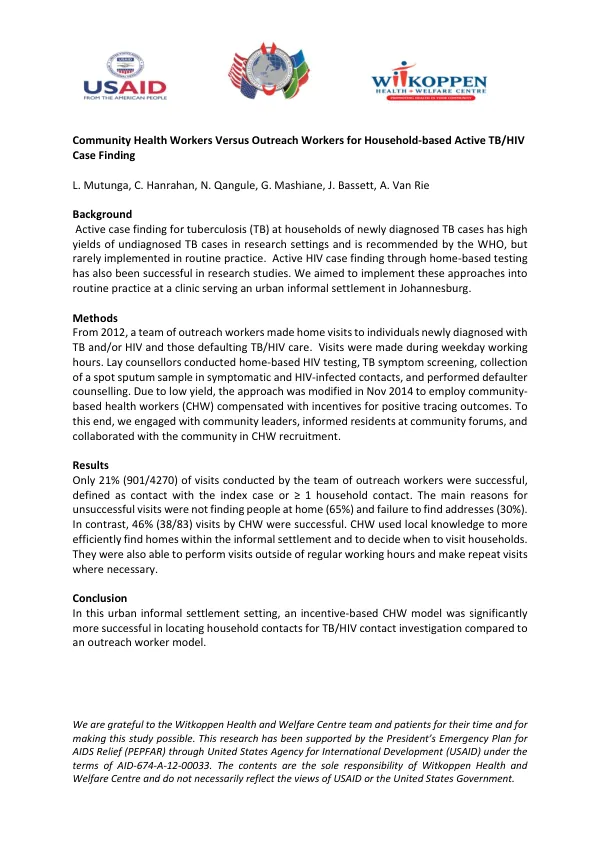
The study was supported by the President's Emergency Plan for AIDS Relief (PEPFAR) through the United States Agency for International Development (USAID). The research aimed to translate research findings into routine practice at a clinic serving an urban informal settlement in Johannesburg. The study began in 2012, with a team of outreach workers making home visits to individuals newly diagnosed with TB and/or HIV and those defaulting TB/HIV care. However, the visits were not successful, with only 21% of attempts resulting in contact with the index case or at least one household contact. The main reasons for unsuccessful visits were not finding the individuals at home and failure to find their addresses. In contrast, a modified approach was implemented in November 2014, which employed CHW compensated with incentives for positive outcomes. The CHW were able to use their local knowledge to more efficiently find homes within the informal settlement and to decide when to visit households. They were also able to perform visits outside regular working hours and make necessary follow-up visits where needed. The CHW model was found to be more successful, with 46% of visits resulting in contact with the index case or at least one household contact. The study found that the CHW model was more effective in locating household contacts for TB/HIV case investigation compared to the outreach worker model. The CHW were able to use their knowledge of the community to locate individuals and make necessary follow-up visits. This approach has the potential to improve TB/HIV case finding and treatment outcomes in urban informal settlements. The study highlights the importance of engaging with the community and using local knowledge to improve health outcomes. The CHW model has been shown to be effective in finding household contacts for TB/HIV case investigation, and it has the potential to be scaled up to other settings. The study's findings have implications for the development of effective TB/HIV control programs in urban informal settlements.