USAID DEC
Community HIV Prevention Volunteers Participants Handbook for adult priority populations
Sign inPACT
Community HIV Prevention Volunteers Participants Handbook for adult priority populations
The USAID Zambia Community HIV Prevention Project (USAID Z-CHPP) targets specific adult priority populations that can either transmit the Human Immunodeficiency Virus (HIV) or are at risk of being infected.
2017 · 47 pages
Sign in to readA free account is required to download.
Abstract
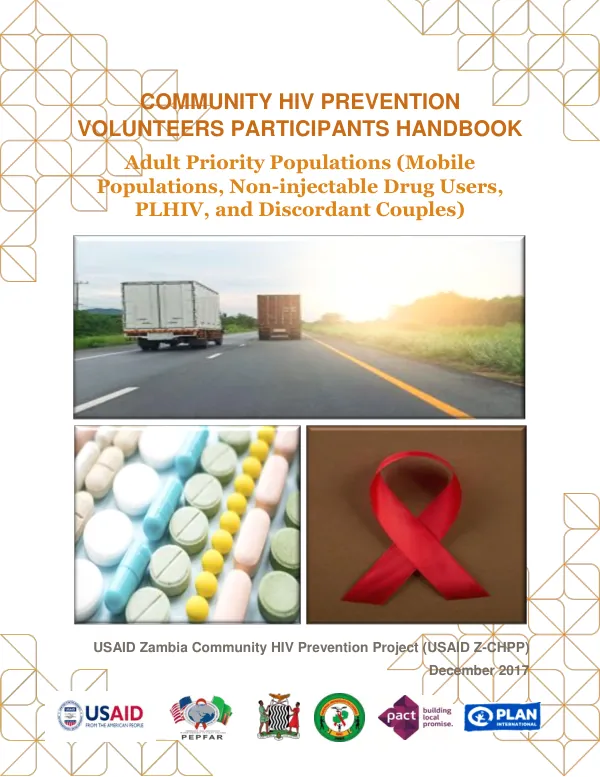
These populations include mobile populations, non-injectable drug users, discordant couples, and People Living with HIV (PLHIV). Mobile populations, such as miners, sugarcane cutters, fish mongers, truck drivers, and cross-border traders, are at risk due to factors such as having multiple concurrent sexual partners, using alcohol that may lead to unprotected sex, experiencing sexual violence and exploitation, and lacking regular access to healthcare facilities. The relationship between population mobility and the spread of HIV has received increased attention in developing countries, including Zambia. As PLHIV are now living longer and healthier lives due to the greater availability of Anti-Retroviral Therapy (ART), the urgency to include behavior change strategies for PLHIV into the public health system increases. Studies from Sub-Saharan Africa have shown that PLHIV are sexually active, and sexual risk behavior among people receiving ART is a major public health concern due to the risk of HIV transmission and the potential risk of transmission of resistant strains. Mobile populations are those who move from one place to another for economic reasons, and in the context of USAID Z-CHPP, this term specifically refers to civilian mobile populations who travel seasonally and/or temporarily to find work and income. The risk characteristics for mobile populations include having multiple concurrent sexual partners, using alcohol that may lead to unprotected sex, experiencing sexual violence and exploitation, poor living conditions, and lack of access to healthcare facilities. The USAID Z-CHPP aims to address the specific needs of these populations through a range of interventions, including HIV testing services, Anti-Retroviral Therapy, and behavior change strategies. The project also aims to reduce stigma and discrimination against PLHIV and to promote positive living. The project's approach is based on the understanding that PLHIV are not just passive recipients of care, but also active agents who can take control of their health and well-being. The project's interventions are designed to be tailored to the specific needs of each population, taking into account their unique risk characteristics and vulnerabilities. For example, mobile populations may require interventions that address their mobility and the associated risks, such as providing access to HIV testing and counseling services at border crossings and transportation hubs. Non-injectable drug users may require interventions that address their substance use and the associated risks, such as providing access to harm reduction services and counseling. The project's approach is also based on the understanding that behavior change is a complex process that requires a range of interventions, including education, counseling, and social support. The project's interventions are designed to be comprehensive and to address the multiple factors that contribute to HIV risk and transmission. By addressing the specific needs of each population and providing a range of interventions, the project aims to reduce HIV risk and transmission among these populations and to promote positive living and well-being.