SAVE THE CHILDREN FUND
Preventing Pregnancy STIs and HIV
Preventing pregnancy, STIs, and HIV is a critical concern for adolescents.
2 pages
Sign in to readA free account is required to download.
Abstract
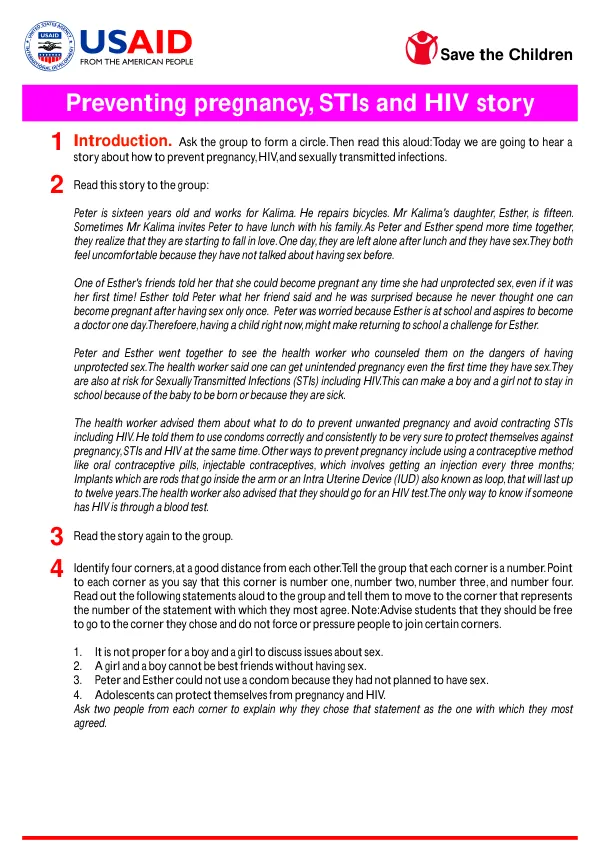
The story of Peter and Esther, two teenagers who engage in unprotected sex, highlights the risks of unintended pregnancy and Sexually Transmitted Infections (STIs), including HIV. The health worker's counsel emphasizes the importance of using condoms consistently to prevent pregnancy and prevent STIs, including HIV. Adolescents face various challenges in using condoms, including lack of access to information, misconceptions about condom use, and social norms that discourage open discussions about sex. In some communities, there is a misconception that a girl cannot be best friends with a boy without engaging in sex. This misconception can lead to a lack of open communication about sex and relationships. Teenage pregnancy poses significant risks for both the mother and the child. The mother may face challenges in returning to school or pursuing her education, while the child may be born with health complications. STIs, including HIV, can also have severe consequences for adolescents, including infertility, chronic illness, and even death. The use of condoms is a critical preventive measure against unintended pregnancy and STIs, including HIV. Condoms are available in various forms, including male condoms, female condoms, and other barrier methods. Adolescents can also use other forms of contraception, such as injectable contraceptives, implants, and intrauterine devices (IUDs). Adolescents can access information about preventing pregnancy, STIs, and HIV from various sources, including health centers, Health Surveillance Assistants (HSAs), and Youth Community Distribution Agents (YCDAs). These sources provide accurate information about the risks of unprotected sex, the benefits of using condoms, and the availability of other forms of contraception. In conclusion, preventing pregnancy, STIs, and HIV is a critical concern for adolescents. The use of condoms is a critical preventive measure against unintended pregnancy and STIs, including HIV. Adolescents can access information about preventing pregnancy, STIs, and HIV from various sources, including health centers, HSAs, and YCDAs. By making informed decisions about sex and relationships, adolescents can reduce their risk of unintended pregnancy and STIs, including HIV. Adolescents can also make a commitment to find out more information about preventing pregnancy, STIs, and HIV. This commitment can involve visiting a health center, speaking with a Health Surveillance Assistant (HSA), or accessing information from a Youth Community Distribution Agent (YCD). By taking this commitment, adolescents can take control of their reproductive health and reduce their risk of unintended pregnancy and STIs, including HIV. In many communities, there are misconceptions about sex and relationships that can make it difficult for adolescents to access accurate information about preventing pregnancy, STIs, and HIV. These misconceptions can include the idea that a girl cannot be best friends with a boy without engaging in sex. However, this misconception can be challenged by providing accurate information about the risks of unprotected sex and the benefits of using condoms. The consequences of teenage pregnancy can be severe, including challenges in returning to school or pursuing education. STIs, including HIV, can also have severe consequences, including infertility, chronic illness, and even death. Therefore, it is essential for adolescents to make informed decisions about sex and relationships to reduce their risk of unintended pregnancy and STIs, including HIV.
Related documents