USAID DEC
Community-Led Monitoring Drives Tailored Solutions and Improves Focus on Client-Centered Services
Sign inFHI 360
Community-Led Monitoring Drives Tailored Solutions and Improves Focus on Client-Centered Services
Client-centered health services require an understanding of service user perspectives, including their experiences, challenges, and challenges.
2021 · 6 pages
Sign in to readA free account is required to download.
Abstract
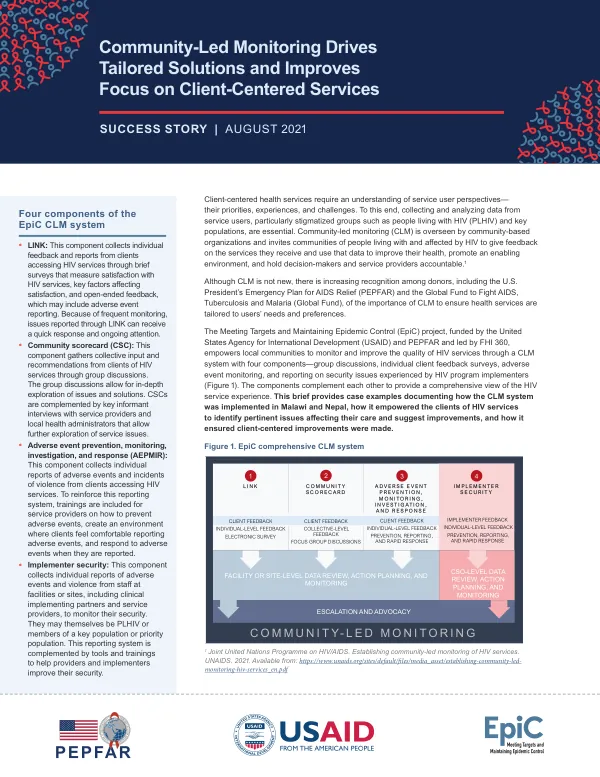
Collecting and analyzing data from service users, particularly stigmatized groups such as people living with HIV (PLHIV), is essential. Community-led monitoring (CLM) is a process that invites communities of people living with and affected by HIV to provide feedback on the services they receive and use that data to improve their health, promote an enabling environment, and hold decision-makers and service providers accountable. The Meeting Targets and Maintaining Epidemic Control (EpiC) project, funded by the United States Agency for International Development (USAID) and the President's Emergency Plan for AIDS Relief (PEPFAR), empowers local communities to monitor and improve the quality of HIV services through a CLM system with four components: group discussions, individual client feedback surveys, adverse event monitoring, and reporting on security issues experienced by HIV program implementers. The CLM system provides a comprehensive view of the HIV service experience. The EpiC comprehensive CLM system includes four components: LINK, Community Score Card (CSC), Adverse Event Prevention, Monitoring, Investigation, and Response (AEPMIR), and Implementer Security. The LINK component collects individual feedback and reports from clients accessing HIV services through surveys that measure satisfaction with HIV services, key factors affecting services, and open-ended feedback. The CSC component gathers collective input and recommendations from clients of HIV services through group discussions, which allow for in-depth exploration of issues and solutions. The AEPMIR component collects individual reports of adverse events and incidents of violence from clients accessing HIV services, and the Implementer Security component collects individual reports of adverse events and violence from staff at facilities or sites. In Malawi, the EpiC program implemented the LINK individual-level feedback survey since 2017. The survey is administered in person on tablets by peers, including members of key groups or outreach workers whom clients trust. Suggestion boxes for adverse event prevention, monitoring, investigation, and response have been available in health facilities since 2017. The program became aware of issues clients were facing when accessing services through data from the LINK surveys and comments from the suggestion boxes. Clients frequently raised concerns about long waiting times at facilities. The EpiC Malawi team decided to implement the community score card (CSC) component of CLM, which includes a question on wait times. The scorecard was used to ask, "How convenient are the waiting times of HIV testing and counseling services?" Group discussions were conducted in three districts, including Lilongwe, Machinga, and Zomba, with members of key population groups receiving services from seven health facilities. The group discussions allowed clients to assign scores to services provided by each site, with an average score of 3.3 for the Mlomba Health Center. The group discussion included nine questions on access to services, with four questions receiving a "poor' rating, one of which was wait time. The findings of the CSC for the Mlomba Health Center showed that the average score of the eleven technical areas was 3.3, with three technical areas scoring below average. The group discussion included nine questions on access to services, with four questions receiving a "poor' rating, one of which was wait time. The group discussion provided the opportunity to delve deeper into the issues affecting client-centered service delivery. It became clear that the reporting of long wait times was not consistent across facilities. For example, in one drop-in center in Lilongwe, a focus group among transgender individuals scored wait time as "good," but suggested having two counselors to speed up the process. The EpiC Malawi team held an action planning meeting with stakeholders, including the health facility and district health office staff, to present the issues discussed. The meeting included representatives from the FSWs and staff of the health facility, DHO, and CSO. The CSO staff summarized the main issues identified through the group discussions and explained the need for improvements. The meeting resulted in the development of an action plan to address the issues identified through the CLM system. The action plan included the implementation of a first-come, first-served system at the Mlomba Health Center, which would reduce wait times and improve client-centered services. The plan also included the training of staff on client-centered communication and the provision of additional resources to support the implementation of the plan. The action plan was developed in collaboration with stakeholders, including the health facility and district health office staff, and was based on the findings of the CLM system. The implementation of the CLM system and the action plan resulted in improvements in client-centered services, including reduced wait times and improved communication between clients and service providers. The CLM system provided a comprehensive view of the HIV service experience and allowed for the identification of issues affecting client-centered service delivery. The system empowered local communities to monitor and improve the quality of HIV services, and held decision-makers and service providers accountable for the quality of services provided.
Related documents