USAID
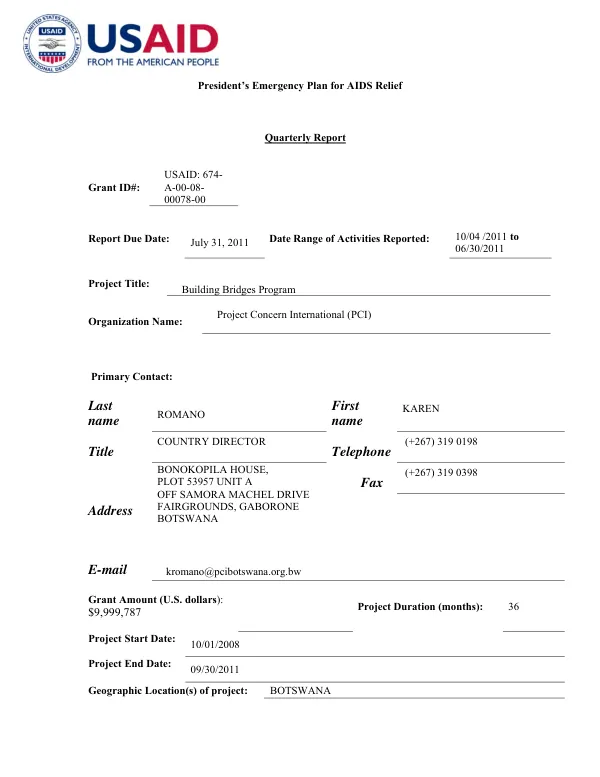
President’s Emergency Plan for AIDS Relief Quarterly Report
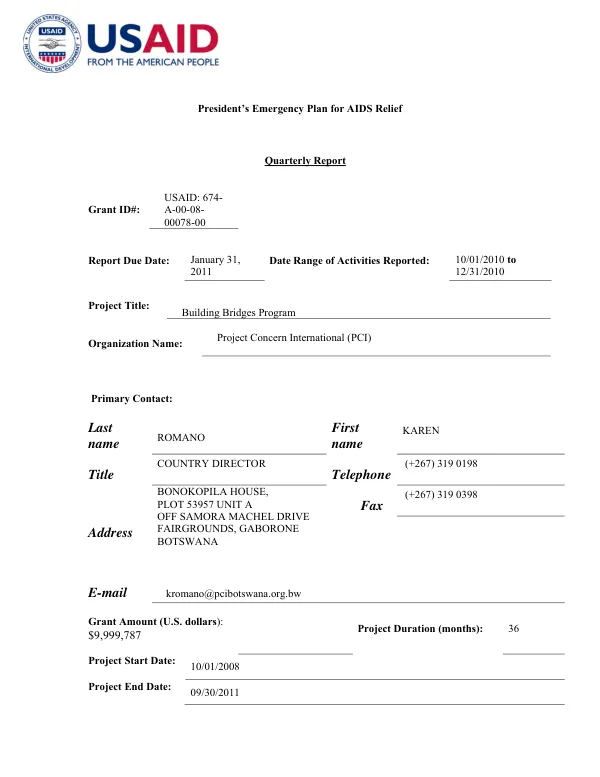
The Building Bridges Program in Botswana, implemented by Project Concern International (PCI), aims to strengthen the role of civil society organizations (CSOs) in delivering comprehensive care and support services for HIV-affected families and vulnerable youth.
2011 · 20 pages
Sign in to readA free account is required to download.
Abstract
The program is funded by the President's Emergency Plan for AIDS Relief (PEPFAR) and has a grant amount of $9,999,787. The program's goal is to improve and expand CSO delivery of integrated HIV/AIDS services for affected/infected children and families. To achieve this goal, PCI provides sub-grants and technical assistance to 11 NGO partners, as well as funding support and technical assistance to two umbrella organizations, BONASO and BONEPWA+. The program also collaborates with government counterparts at national and district levels. The program has made significant progress in achieving its objectives. Currently, the Building Bridges Program has a complement of 18 staff, with all positions filled. The program has also transitioned to a new project on Orphans and Vulnerable Children and Gender, which started in June 2011. During the reporting period (April 1 - June 30, 2011), the 11 PCI-supported NGO partners continued to provide care and support services to families and communities in need. The partners used three main strategies to provide services: the comprehensive family care approach, community mobilization using the Journey of Life (JOL) methodology, and Food Nutrition and Livelihood Security (FNLS). These strategies complement each other to ensure that individuals and families are able to cope and deal with their situations with support from the community, NGOs, schools, and other entities within their environment. The NGO partners reached a total of 7,021 clients (3,833 children and 3,188 adults) with a minimum of one care service against a target of 2,974 set for the quarter. The partners also reached a total of 1,828 clients (142 below 15 and 1,686 above 15 years) with a minimum of one clinical service against a target of 951 set for the quarter. The NGO partners have internalized the processes followed during service provision according to the guidelines and tools provided by PCI, which has eased their workload and minimized errors. The program has also made progress in providing ART adherence support to families and improving linkages with IDCC. Four of the NGO partners have continued running teen clubs for adolescents living with HIV, and BAPL was able to enroll 44 adolescents in the feasibility study of how to use short message services (SMS) to improve adherence. The text messaging reminds clients of their doctor appointments, prescription refills, and sends individualized pill reminders. The program's success can be attributed to the experience gained by the NGO partners over time in provision of comprehensive services to families. The data base has also eased their workload and minimized errors that used to happen during collation of data, which was done manually. The program's progress is a testament to the effectiveness of the Building Bridges Program in strengthening the role of CSOs in delivering comprehensive care and support services for HIV-affected families and vulnerable youth in Botswana.