USAID DEC
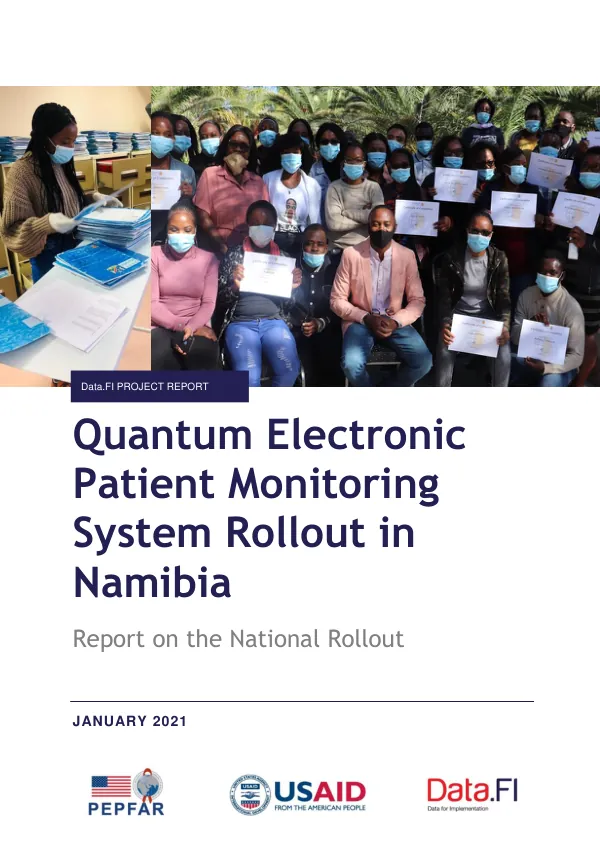
Quantum Electronic Patient Monitoring System Rollout in Namibia: Report on the National Rollout
Sign inCDC
Quantum Electronic Patient Monitoring System Rollout in Namibia: Report on the National Rollout
The Quantum Electronic Patient Monitoring System (QePMS) rollout in Namibia began in May 2020, with the Ministry of Health and Social Services (MOHSS) approval for a national rollout of the new system.
2021 · 20 pages
Sign in to readA free account is required to download.
Abstract
The rollout was implemented in all 14 regions of Namibia from June 2020 to January 2021, with the QePMS installed at 359 public health facilities. The system was designed to improve patient monitoring and management for HIV and tuberculosis patients. The rollout was carried out by IntraHealth Namibia, with funding from the United States President's Emergency Plan for AIDS Relief (PEPFAR) through two USAID projects: the USAID HIV Clinical Services Technical Assistance Project (UTAP) and Data.FI. Activities at the facilities were implemented in collaboration with MOHSS facility staff, supported by national-level MOHSS staff and staff from the PEPFAR-supported project, International Training and Education Center for Health (I-TECH). A total of 344 health workers were trained to manage and use the QePMS, and equipment was provided to support the new system. Data cleaning was carried out during the rollout to improve the quality of data migrated to the new system. The results showed that within each region, the number of active patients in the QePMS after data cleaning was within 10 percent of the number of active patients reported using the legacy system. However, nearly half of the health facilities providing antiretroviral therapy (ART) services did not have access to the MOHSS wide area network or to the Internet at the time the QePMS was installed. This limited the full capabilities of the upgraded system and hindered information technology (IT) support for health facilities. The rollout team recommends an investment in connectivity to enable all facilities to take advantage of the full capabilities of the upgraded system, facilitate remote technical support from IT officers, and improve communications among health workers. The QePMS was designed to improve patient monitoring and management, and its successful rollout in Namibia has the potential to improve health outcomes for HIV and tuberculosis patients in the country. The QePMS rollout in Namibia was a complex process that involved multiple stakeholders and required significant resources. The rollout team worked closely with MOHSS facility staff, national-level MOHSS staff, and staff from the PEPFAR-supported project, I-TECH, to implement the new system. The team also provided training to 344 health workers to manage and use the QePMS, and equipment was provided to support the new system. The QePMS was installed at 359 public health facilities in Namibia, and 99 percent of patient data were migrated from the legacy system (LePMS) to the QePMS. The rollout team carried out data cleaning during the rollout to improve the quality of data migrated to the new system. The results showed that within each region, the number of active patients in the QePMS after data cleaning was within 10 percent of the number of active patients reported using the legacy system. The rollout team faced several challenges during the implementation of the QePMS, including the COVID-19 pandemic, which impacted the rollout process. The team also encountered remaining concerns, including the need for investment in connectivity to enable all facilities to take advantage of the full capabilities of the upgraded system. The rollout team recommends addressing these challenges to ensure the successful implementation of the QePMS in Namibia.