GOVERNMENT OF COLOMBIA
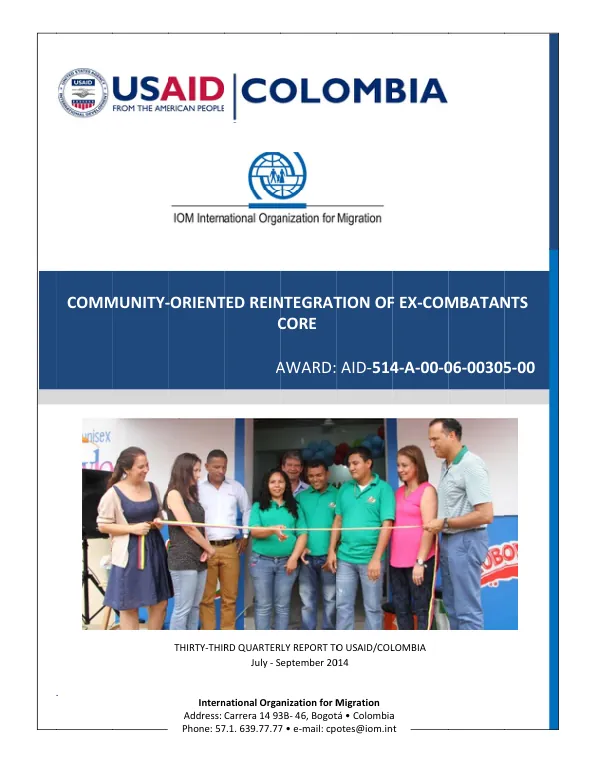
Community-Oriented Reintegration of Ex-combatants - CORE
The Community-Oriented Reintegration of Ex-combatants (CORE) program in Colombia aims to support the government in implementing laws related to the reintegration and legal status of ex-combatants.
2014 · 61 pages
Sign in to readA free account is required to download.
Abstract
CORE works with government entities to develop tools and methodologies that support the implementation of these laws. The program's goal is to pass these instruments to the agencies after a period defined by the entities involved. The timeline for transfer depends on the project. Various contextual shifts that affect CORE have presented themselves this quarter. With respect to the peace process, it became clear that the limited release of information from the peace process had left much of the population in the dark with respect to progress in the talks. In addition, as the Government of Colombia (GOC) looks to international examples of peace agreement implementation, it has become clear that one of the challenges to peace agreements is the trust and legitimacy with which society views them and the preparation of society for the post-conflict stage. The dissemination of information about the peace process therefore became a priority for the GOC in order to overcome this weakness in the peace process model. Meanwhile, one of the greatest challenges faced by the Justice and Peace process is the lack of public clarity about the conditional freedom of the people whose cases are being processed under the Law and who have finished the eight years established as the maximum alternative sentence, which implies significant institutional challenges. The Tracking, Monitoring, and Evaluation System (SAME) team provides technical support to assess psychosocial readiness for reintegration. This quarter, 983 surveys were conducted, and 51% of the participants fulfilled requisites required by the Colombian Reintegration Agency (ACR) to continue with the graduation process. The ACR reported 2,521 people graduating from the reintegration process in this quarter, meaning that 7,219 people have graduated from the reintegration process throughout its existence. In addition, the SIR and ISUN were used to systematize 122 monitoring visits made to business units this quarter (individual productive projects) that have received seed capital funding. Of these, 102 (84%) business units were in operation, and 20 (16%) had closed. The SAME team also focused on its closing activities and transfer of its models to the ACR. In terms of economic reintegration, implementation of the "Integrated Employment Intervention Route" continued. This methodology aims to support demobilized individuals in exploring and finding opportunities in the job market through activities such as identification of job vacancies, vocational assessment, occupational orientation, job engagement, and monitoring and support for individuals in the process of reintegration who are professionally engaged with businesses, as well as monitoring and support for the businesses themselves. By the end of this quarter, 807 businesses had been made aware of the initiative, and 598 people in the process of reintegration have been employed by 122 businesses, thereby providing them with formal employment (including benefits as stipulated by law). The process of transferring the methodology to the ACR reintegration professionals continued through the joint implementation of activities and the implementation of 46 training workshops, through which 120 ACR professionals have been trained. Projects continue to support the various sub-units of the Justice and Peace Unit in the Attorney General's office. These activities focus on land restitution, facilitating sentencing in high-priority cases, strengthening the ACR's capacity to identify and return human remains to victims' families, complementing the construction of patterns of macro-criminality with similar investigations of macro-victimization, and strengthening regional work in the sub-units. Results this quarter included the conclusion of activities with the Prosecution of Assets Sub-Unit, the analysis of 133 DNA samples by the Exhumations sub-unit, and the compilation of 1,100 kits to identify individuals.