GOVERNMENT OF COLOMBIA
DDR & children’s issues: A BI-MONTHLY REVIEW
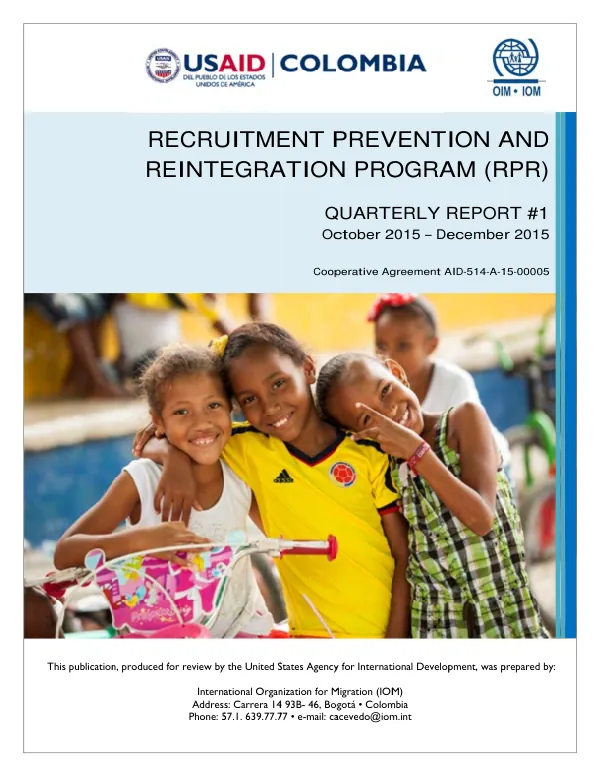
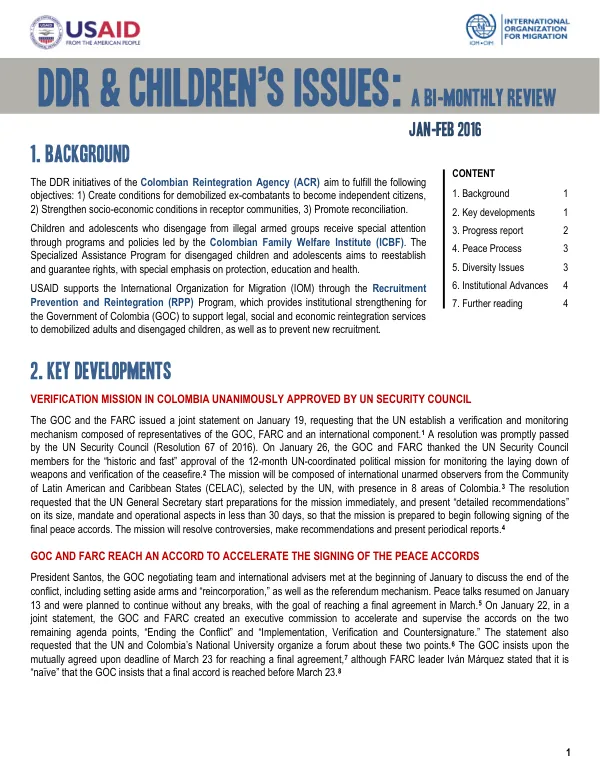
The Colombian Reintegration Agency (ACR) aims to create conditions for demobilized ex-combatants to become independent citizens, strengthen socio-economic conditions in receptor communities, and promote reconciliation.
2016 · 4 pages
Sign in to readA free account is required to download.
Abstract
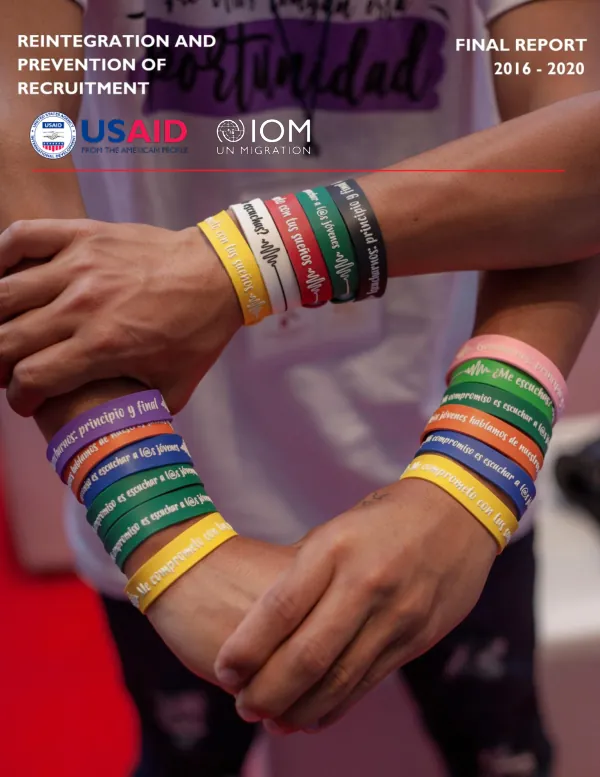
The ACR's DDR initiatives are complemented by programs and policies led by the Colombian Family Welfare Institute (ICBF) to address the needs of children and adolescents who disengage from illegal armed groups. The Specialized Assistance Program for disengaged children and adolescents focuses on reestablishing and guaranteeing rights, with special emphasis on protection, education, and health. The Government of Colombia (GOC) and the FARC issued a joint statement on January 19, requesting that the UN establish a verification and monitoring mechanism composed of representatives of the GOC, FARC, and an international component. The UN Security Council promptly passed Resolution 67 of 2016, which established a 12-month UN-coordinated political mission for monitoring the laying down of weapons and verification of the ceasefire. The mission will be composed of international unarmed observers from the Community of Latin American and Caribbean States (CELAC), with presence in 8 areas of Colombia. The GOC and FARC reached an accord to accelerate the signing of the peace accords, with the goal of reaching a final agreement in March. The GOC insists upon the mutually agreed upon deadline of March 23, although FARC leader Iván Márquez stated that it is "naïve" that the GOC insists on a final accord before March 23. The peace process has made significant progress, with over 500 participants attending a final public forum on the peace process from February 8-10. The forum aimed to facilitate participation of civil society and the general public in the development of solutions and concrete proposals on the remaining two points on the agenda. According to data up to February 29, 2016, a total of 5,958 disengaged minors were identified, with boys historically being more frequently recruited than girls. The majority of disengaged children were recruited by the FARC, and indigenous groups are disproportionately affected by recruitment. The average age of recruitment is between 15 and 18 years old. A total of 57,822 demobilized adults were also identified, with the AUC having the lowest proportion of women. The top 8 departments for adult relocation are Antioquia, Bogotá D.C., Córdoba, Meta, Cesar, Valle del Cauca, Santander, and Magdalena. The International Criminal Court has set conditions for endorsing the peace agreements, stating that the accords should include issues of accountability for those responsible for war crimes and crimes against humanity. President Santos responded that there will be no amnesty for crimes against humanity, serious war crimes, and serious violations of human rights and international humanitarian law. The FARC negotiation team visited the department of La Guajira on February 18, accompanied by several armed men, which was met with controversy and calls for the suspension of visits of FARC leaders to their camps.