USAID DEC
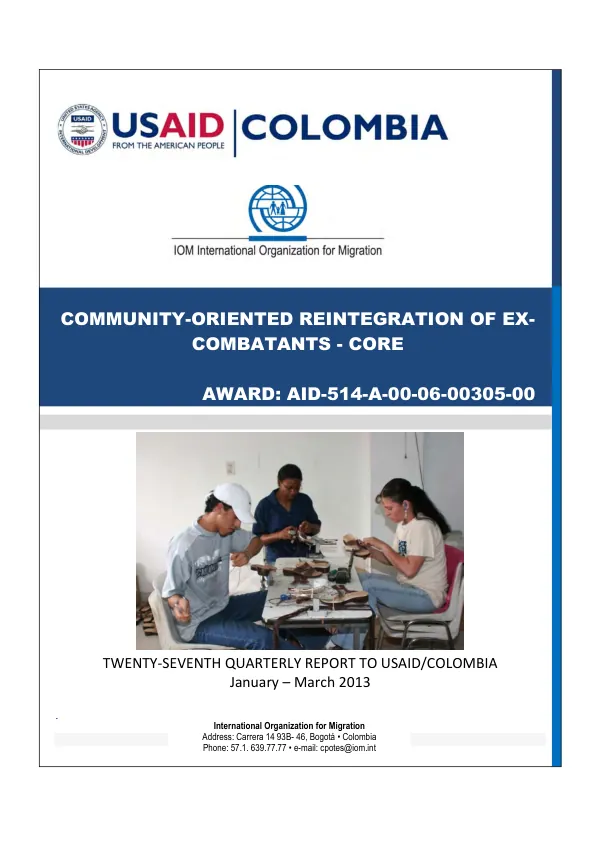
Twenty-Seventh Quarterly Report to USAID/Colombia: Community-Oriented Reintegration of Ex-Combatants - CORE
Sign inFUNDACIÓN IDEAS PARA LA PAZ
Twenty-Seventh Quarterly Report to USAID/Colombia: Community-Oriented Reintegration of Ex-Combatants - CORE
The Community-Oriented Reintegration of Ex-combatants - CORE program in Colombia aims to support the government in implementing laws related to the reintegration and legal status of demobilized ex-combatants.
2013 · 39 pages
Sign in to readA free account is required to download.
Abstract
The program has worked with governmental entities to develop tools and methodologies that support the implementation of these laws. CORE's goal is to pass these instruments to partner agencies after a period defined by the entities involved. The Tracking, Monitoring and Evaluation System (SAME) team has provided technical support to assess psychosocial readiness for reintegration among 613 individuals through the IECC, as well as of participant business units, where appropriate, through the ISUN. In terms of economic reintegration, the CORE partner agency - the Colombian Agency for Reintegration (ACR) - considers the models for job training and formulation and implementation of business plans to be highly successful and sees them as key elements in its economic reintegration toolkit. New projects have been developed to support the Attorney General's office in constructing contexts of macro-criminality in terms of land usurpation and forced abandonment, to facilitate sentencing in high-priority cases and attribution of crimes to those who fall under commanders' supervision. The ongoing project supporting the Exhumations Sub-Unit has received and digitized 200 biological samples required in the process of identification of remains, and created 180 genetic profiles based on the DNA samples received. The ongoing Interinstitutional Information System for Justice and Peace, or SIIJYP, is now being used by the Attorney General's Office, Ministry of Justice and Law, Office of the Ombudsman, and the Victims' Unit. The SIIJYP team is training regional offices of these entities, and working to incorporate others to the system. CORE has also reinforced ACR efforts in the development of community service activities that facilitate reconciliation between the community and the demobilized individuals participating in the reintegration process under Law 1424 of 2010. 49 community service action plans were formulated, involving 919 participants, or 25% of the goal number for this year. Intermediate Result 3: "GOC Supported to Develop Conflict Management Strategies" focuses on building knowledge as well as technical and operational abilities of the GOC for conflict management. This recently created work area has begun to produce informational documents about the current peace process in Colombia and compile research documents regarding the demobilization of the FARC and other issues related to the DDR side of the peace process. The team also organized an event called "Challenges and perspectives on an eventual peace agreement between the Government and the FARC", which was attended by representatives of the ACR, the Center for Historical Memory (CMH), the Ministry of the Interior, the Ministry of Justice and Law, the Attorney General's Office, and other governmental entities. Other projects that also contribute to the realization of this objective are being developed with Fundación Ideas para la Paz, involving the systematization of civil society proposals related to the current peace process, and monitoring and analysis of conflict dynamics and peace negotiations. A project with Fundación Social will create a National Reconciliation Index (IRN), a tool that aims to evaluate, monitor, and modify reconciliation policies based on four dimensions: trust; democracy; land; and victims' rights. Projects in these areas have been formulated in this quarter and expect to see further results in the next. The Attorney General's Office created the "Action Plan for Case Prioritization", which focuses research and legal resources on high-priority cases that deal with those ultimately responsible for violations of human rights and infractions of International Humanitarian Law. This means that unit commanders' cases are investigated and the charges against them decided based on specific events such as massacres, forced displacement, and others. The associated shift from processing cases individually to prioritizing commanders' cases and bulk-processing their subordinates' cases directly affects projects implemented under Intermediate Result 2. Three challenges to the implementation of Program activities were encountered this quarter: the need for additional information about business units operational after participation in income generation projects, and psychosocial competencies; delays in graduating participants from the ACR reintegration program; and the lack of information and certainty surrounding the current peace process between the GOC and the FARC. These challenges may continue to shape the Program's operations and require adjustments to its practices and work models. The CORE has adjusted its practices and developed new tools and work models to accommodate the dynamic environment in which it operates.
Related documents