USAID DEC
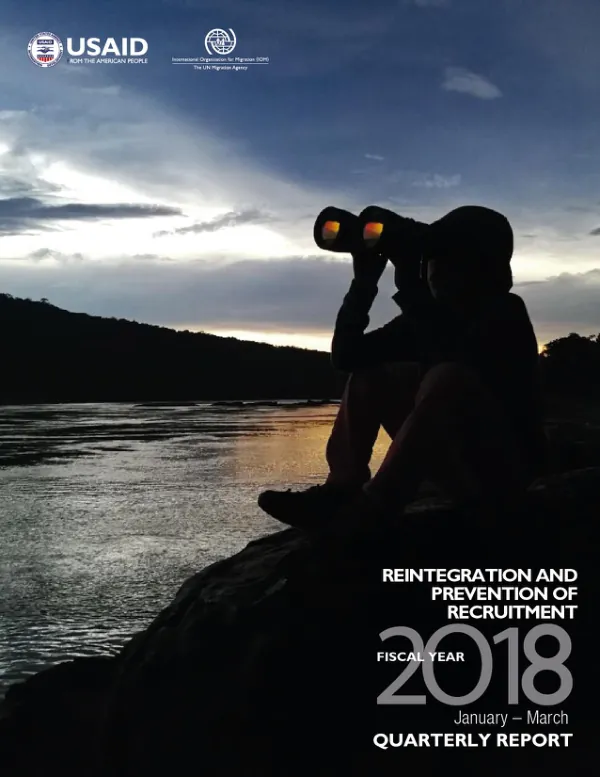
Quarterly Report #10 (Q2 FY2018) for the Recruitment Prevention and Reintegration (RPR) Program in Colombia
Sign inGOVERNMENT OF COLOMBIA
Quarterly Report #10 (Q2 FY2018) for the Recruitment Prevention and Reintegration (RPR) Program in Colombia
The RPR Program, implemented by the International Organization for Migration (IOM) in partnership with the United States Agency for International Development (USAID), aims to support the Government of Colombia (GOC) in fostering sustainable and inclusive reintegration for former combatants and disengaged children, and in preventing further recruitment.
2018 · 41 pages
Sign in to readA free account is required to download.
Abstract
The program's Strategic Objective is to minimize recidivism and prevent new recruitment of adolescents and youth. The RPR Program is structured around four result areas: Roll-out, Prevention, Reintegration, and Coordination and Communication. The Roll-out result area focuses on providing strategic technical assistance to support the early reintegration efforts of the GOC during the demobilization roll-out phase. This includes support to national and/or international verification initiatives. In the Prevention result area, the program supports the GOC implementation of strategies for prevention of recruitment. This includes activities such as community outreach and engagement, awareness-raising campaigns, and provision of alternative livelihoods and education opportunities to vulnerable populations. The Reintegration result area focuses on supporting the GOC in providing reintegration services to former combatants and disengaged children. This includes activities such as provision of vocational training, education, and psychosocial support, as well as assistance with housing and economic reintegration. The Coordination and Communication result area aims to ensure effective coordination and communication among stakeholders, including the GOC, international organizations, and local communities. This includes activities such as capacity building, information sharing, and coordination of efforts to prevent recruitment and promote reintegration. During Q2 of FY2018 (January-March 2018), the RPR Program achieved significant progress in all four result areas. In the Roll-out result area, the program provided technical assistance to support the GOC's early reintegration efforts, including support to national and/or international verification initiatives. In the Prevention result area, the program implemented community outreach and engagement activities, awareness-raising campaigns, and provision of alternative livelihoods and education opportunities to vulnerable populations. These efforts resulted in a significant reduction in recruitment rates among adolescents and youth. In the Reintegration result area, the program provided vocational training, education, and psychosocial support to former combatants and disengaged children. The program also assisted with housing and economic reintegration, resulting in improved living conditions and economic stability for program participants. In the Coordination and Communication result area, the program ensured effective coordination and communication among stakeholders, including the GOC, international organizations, and local communities. This included capacity building, information sharing, and coordination of efforts to prevent recruitment and promote reintegration. Overall, the RPR Program has made significant progress in supporting the GOC's efforts to prevent recruitment and promote reintegration. The program's results demonstrate the importance of a comprehensive approach to addressing the complex challenges of reintegration and recruitment prevention. The program's achievements are outlined in the Summary of Key Quarterly Results and accompanying Map of RPR Program Activities. The program's progress in each result area is detailed in Section 2, Activity Implementation Progress, and the integration of cross-cutting issues is presented in Section 2, Integration of Cross-Cutting Issues. The program's management and administration are described in Section 3, Program Management and Administration, including progress in monitoring, evaluation, and learning; coordination with other USAID-funded programs; conclusions and next steps, and a financial report. Five annexes contain the program results framework, the full table of indicators, a calendar of events, examples of RPR in the news, and program knowledge management products and ad-hoc reports, and visits of USAID representatives to IOM/RPR activities.