USAID DEC
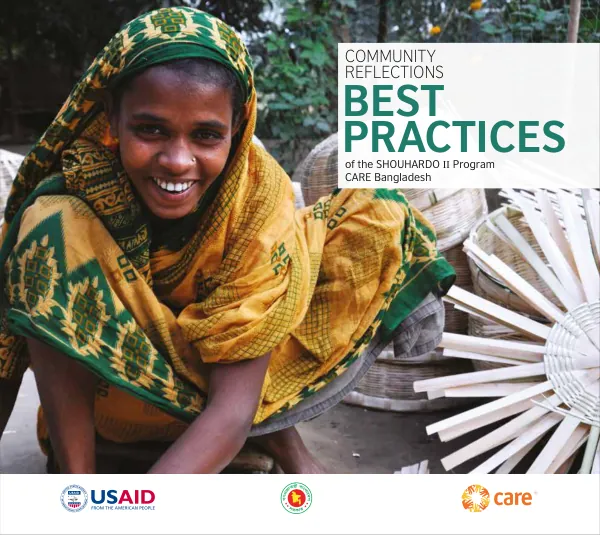
Community Reflections: BEST PRACTICES of the SHOUHARDO II Program
The SHOUHARDO II Program, implemented by CARE Bangladesh, aimed to improve the lives of the ultra-poor in rural Bangladesh.
2015 · 144 pages
Sign in to readA free account is required to download.
Abstract
The program, which began in 2011, focused on enhancing the economic and social well-being of its target population. The initiative was designed to address the complex needs of the ultra-poor, including food insecurity, poverty, and limited access to education and healthcare. The program's approach centered on a holistic strategy that integrated multiple interventions to address the needs of the ultra-poor. The SHOUHARDO II Program implemented a range of activities, including cash transfers, livelihood support, and social protection services. The program also focused on promoting social cohesion and community engagement through the establishment of community-based organizations. These organizations played a crucial role in facilitating social support, providing access to information, and promoting collective action among the ultra-poor. One of the key features of the SHOUHARDO II Program was its emphasis on empowering women and promoting gender equality. The program recognized the critical role that women play in household decision-making and economic management, and sought to enhance their capacity to participate in economic activities and access social services. The program's approach to women's empowerment was grounded in a deep understanding of the social and cultural context of rural Bangladesh, and sought to address the specific challenges faced by women in this setting. The SHOUHARDO II Program achieved significant results in improving the lives of the ultra-poor in rural Bangladesh. The program's impact was evident in the areas of economic empowerment, social protection, and human development. The program's cash transfer component helped to reduce poverty and improve food security, while its livelihood support activities enhanced the economic opportunities available to the ultra-poor. The program's social protection services, including healthcare and education support, helped to improve the health and well-being of the ultra-poor. The SHOUHARDO II Program's success can be attributed to its commitment to community-based approaches and its emphasis on social cohesion and collective action. The program's focus on empowering women and promoting gender equality was also critical to its success, as it helped to address the specific challenges faced by women in rural Bangladesh. The program's results provide valuable insights into the effectiveness of community-based approaches to poverty reduction and social protection, and highlight the importance of empowering women and promoting gender equality in achieving sustainable development outcomes.
Related documents