TETRA TECH
Community Watch Groups Work to Prevent TIP
Community Watch Groups in Myanmar are working to prevent trafficking in persons (TIP) through awareness raising and empowerment of local communities.
2018 · 1 pages
Sign in to readA free account is required to download.
Abstract
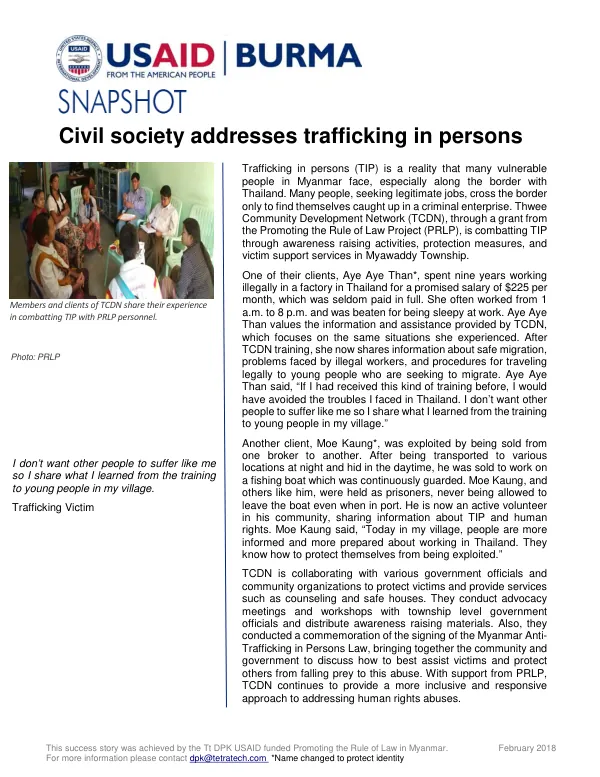
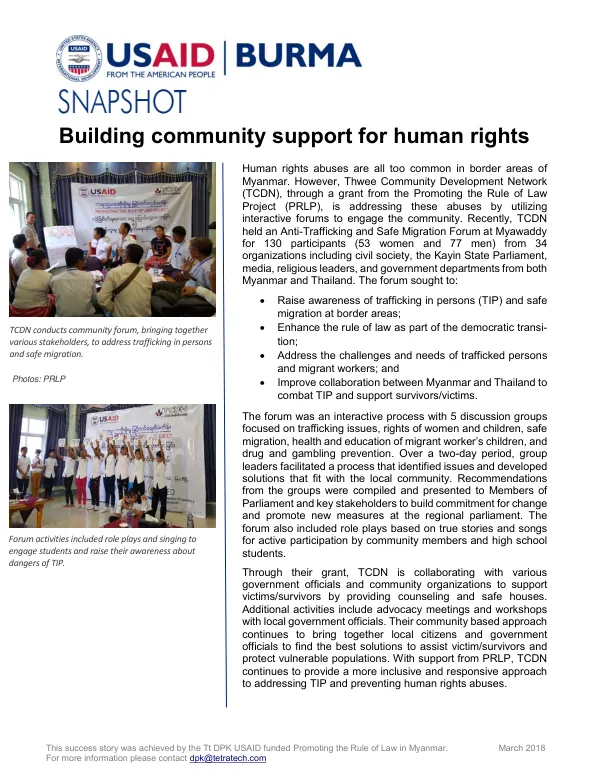
U Nyein Chan, a village farmer and chairperson of a community watch group (CWG), has been instrumental in organizing community awareness sessions to educate villagers and primary and middle school students about the risks of TIP. He was inspired to take action after witnessing instances of TIP in his village, including the case of Ko Tun, who was enslaved in an off-shore fishery for over 15 years. U Nyein Chan's efforts have been supported by the Karuna Mission Social Solidarity (KMSS), which has been working to combat TIP in the Magwe Region, Sagaing Region, and Eastern Shan. KMSS has established CWGs in these areas, comprised of 7 community members, including 4 women, who empower local communities in the fight against TIP. To date, KMSS has completed 16 community awareness raising trainings, 35 CWG awareness sessions, and held an anti-TIP day celebration. U Soe Win, another chairperson of a CWG, has also played a key role in preventing TIP in his village. With his support, Ko Min Min recovered money from an unscrupulous employment broker who was not providing the services for which he was paid. The broker had collected a significant amount of money from at least 6 villagers. KMSS assisted Ko Min Min in obtaining a partial refund and making others aware that no money should be paid in advance to brokers. A majority of men from the villages typically migrate to Thailand or Malaysia for employment, making them vulnerable to TIP. KMSS has been working to prevent TIP by increasing awareness of the pitfalls and providing safe migration information. With grant funding from the Promoting the Rule of Law Project (PRLP), KMSS has implemented various initiatives, including community awareness raising trainings, CWG awareness sessions, and coordination meetings with local CSOs. PRLP is implementing 5 TIP grants with local organizations to increase awareness and prevention, provide assistance for survivors, and offer free legal aid and advice. These efforts aim to empower local communities to take action against TIP and provide support to those who have been affected by it.
Related documents