USAID DEC
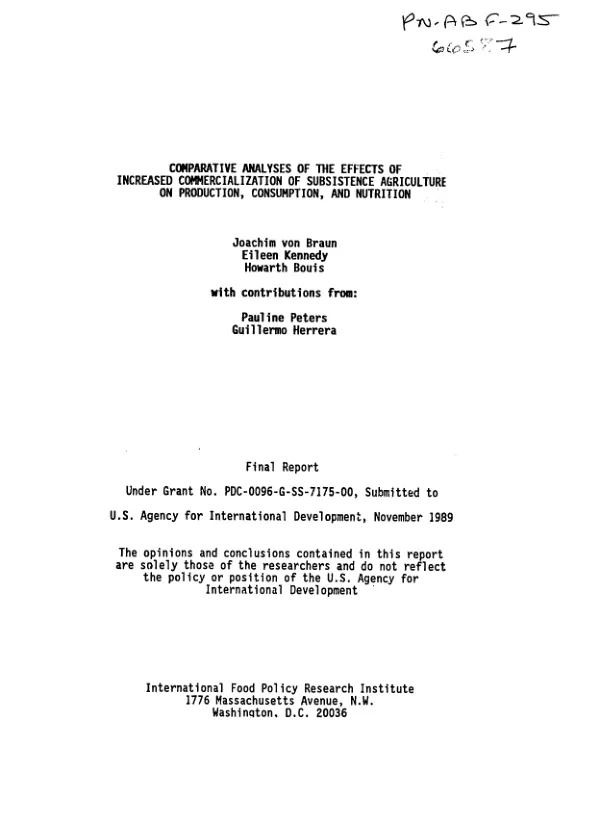
Comparative analyses of the effects of increased commercialization of subsistence agriculture on production, consumption and nutrition
Sign inINTERNATIONAL FOOD POLICY RESEARCH INSTITUTE (IFPRI)
Comparative analyses of the effects of increased commercialization of subsistence agriculture on production, consumption and nutrition
The effects of the commercialization of agriculture on household- level food security and nutrition are not necessarily positive.
von Braun, Joachim; Kennedy, Eileen +1 more · 1989
Sign in to readA free account is required to download.
Abstract
This report presents results of research conducted on households in six countries -- The Gambia, Guatemala, Kenya, the Philippines, Malawi, and Rwanda -- undergoing a transition from semi-subsistence farming to a mix of staple food and cash crop production. Findings concern the effects of commercialization on: staple food production, income and income use, food and nonfood expenditures, calorie availability, and the health and nutritional status of women and preschoolers. Key findings are as follows. (1) Commercialization increases household food security the most when resulting income and employment are concentrated among the malnourished poor. (2) Smallholders make a conscious effort to maintain subsistence food production along with new cash crops. (3) Research and extension policies, as well as inputs for subsistence crops, are critical for a viable commercialization strategy. (4) Employment effects on the poor are very crop-specific. (5) Commercialization substantially expands the demand for hired labor. (6) Commercialization has positive income effects, but not necessarily for all households or for all components of the process. (7) Women"s work in cash crops and their direct control over income is much less than men"s and often disproportional to their labor input. (8) In households with rising income, the total amount spent on food increases; expenditures for health, housing, and clothing also tend to rise. (9) Poor households use incremental income to build up their asset base. Policy support, specifically, the rapid development of rural financial markets, is thus of utmost importance in the commercialization process. (10) The income-consumption link leads to positive effects on child nutrition. However, these improvements are not large and decrease at the margin. Also, positive effects of income on child health are overshadowed by poor community health and sanitation environments.