USAID DEC
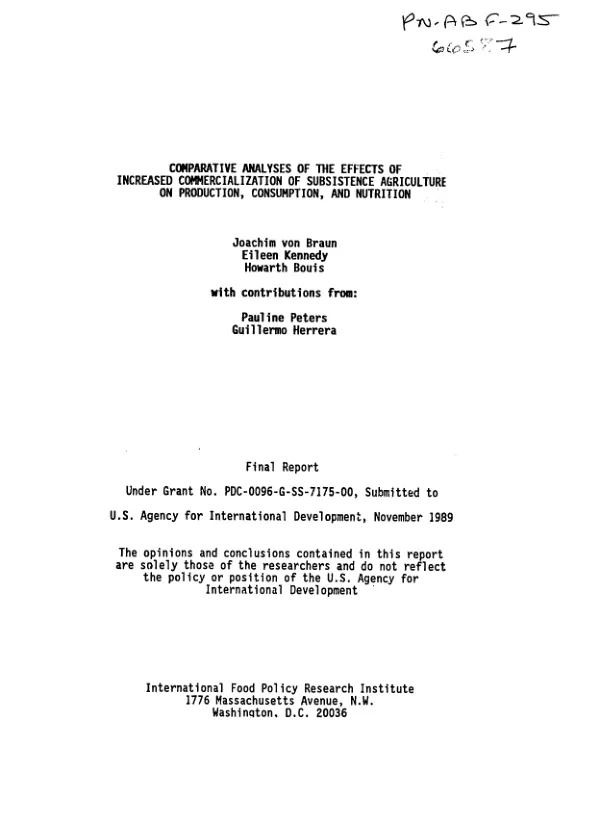
Income and nutritional effects of the commercialization of agriculture in southwestern Kenya
Sign inINTERNATIONAL FOOD POLICY RESEARCH INSTITUTE (IFPRI)
Income and nutritional effects of the commercialization of agriculture in southwestern Kenya
Addressing the debated question of the effect on nutrition of the widespread commercialization of agriculture in developing countries, this survey assesses the nutritional effect of a shift from a subsistence crop (maize) to a commercial crop (sugarcane) among smallholders in Kenya"s South Nyanza district, which has the highest child mortality rate of any district in Kenya.
Kennedy, Eileen T.; Cogill, Bruce · 1987
Sign in to readA free account is required to download.
Abstract
The survey, based on a random sample of farmers at various stages of sugarcane farming and on data over two maize-growing seasons, details the trade-offs between maize and sugarcane production and traces the links between sugarcane income and food intake, morbidity, and the nutritional status of women and children. Results suggest that commercial agriculture may have extremely positive effects on household income: the net return to labor for sugar is three times the daily agricultural wage rate and significantly higher than the return to maize. However, sugar income is perceived not as household but as "men"s income", which is usually spent on non-food items such as housing and school fees, whereas women tend to spend incremental income on food. This may be partly due to the fact that women"s income comes in smaller, regular amounts, whereas sugar income comes in one lump sum every 18-24 months. Suggestions for maximizing the nutritional effects of increased income include (1) placing the name of the female as well as the male head of household on the contract for a cash crop (when this is culturally appropriate); and (2) breaking payments for sugar into smaller, more frequent increments. Includes 41 tables.
Connected topics
Related documents