USAID DEC
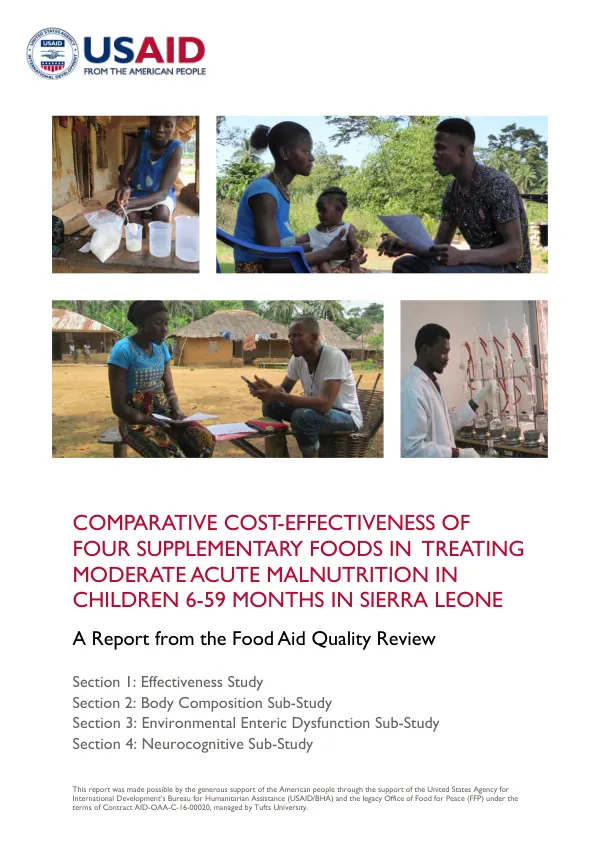
Comparative Cost-Effectiveness of Four Supplementary Foods in Treating MAM in Children 6-59 Months in Sierra Leone
Sign inUNIVERSITÉ DE TUFTS
Comparative Cost-Effectiveness of Four Supplementary Foods in Treating MAM in Children 6-59 Months in Sierra Leone
The Four Foods MAM Treatment Study was conducted in Sierra Leone from April 2017 to November 2018 to evaluate the comparative effectiveness and cost-effectiveness of four specialized nutritious foods (SNFs) in treating moderate acute malnutrition (MAM) among children 6-59 months.
2021 · 176 pages
Sign in to readA free account is required to download.
Abstract
The four foods tested were: CSB+ with fortified vegetable oil (CSB+ w/oil), Corn soy whey blend with fortified vegetable oil (CSWB w/oil), Ready-to-use supplementary food (RUSF), and Super Cereal Plus with amylase (SC+A). The study enrolled 2,691 children, with 2,653 remaining in the sample after exclusion criteria were applied. The unadjusted recovery rates ranged from 62.1 percent to 64.5 percent, with no significant differences in recovery among the foods after adjusting for covariates. Cost per recovered child ranged from $90 to $94, and cost-effectiveness analysis showed no discernable differences among the four foods. However, sustained recovery at four-weeks after discharge was different between RUSF and the comparator CSB+ (73% compared to 81%, p<0.05), but did not alter cost-effectiveness conclusions in cost per child who sustained recovery from the combined perspective. The study also explored certain behavioral factors that may have influenced recovery, including observed consumption of the food by the target child, which was associated with recovery. Intrahousehold sharing rates were similar across arms (~25%) and unassociated with recovery, with rationales for sharing reportedly community views of the foods as being healthy and necessary for childhood well-being. Section 2 of the study focused on body composition, which is an important indicator of health and survival in young children. The study assessed if any of the four SNFs differentially accreted fat mass (FM) and fat-free mass (FFM) as measured by a deuterium dilution. The results showed that approximately 82% of weight gained during the 4-week period was FFM, and children who recovered within 12 weeks gained an average of 0.43 kg FFM during the first 4 weeks of treatment, while those who did not recover by 12 weeks gained an average of 0.22 kg FFM (P = 0.002). There were no food-specific differences in body composition measured in the first four weeks of treatment. Section 3 of the study examined Environmental Enteric Dysfunction (EED), a disorder of the small intestine that may play a role in the etiology and treatment of MAM. The study assessed whether the presence of EED modified the effect of the four SNFs on growth measured by anthropometric indicators and, secondarily, whether any of these SNFs led to change in EED over four weeks of treatment. The results showed that presence of EED at enrollment using any of the biomarkers did not modify the effect of the study foods except for Gut Defense Score (GDS) (p=0.001). More children with high GDS recovered compared to children with lower GDS (p<0.001). There was no change in the fecal host mRNA transcripts between two time points or by study food. Section 4 of the study examined Neurocognitive Function, which is an important aspect of child development. The study tested whether neurocognitive processing, measured by saccadic reaction time, is measurably affected by the presence of MAM. The results showed that children with MAM had slower saccadic reaction times compared to children without MAM, and that the presence of EED was associated with slower saccadic reaction times. The study also found that the eye-tracking test was a feasible and reliable measure of neurocognitive function in young children in low-resource settings.