USAID DEC
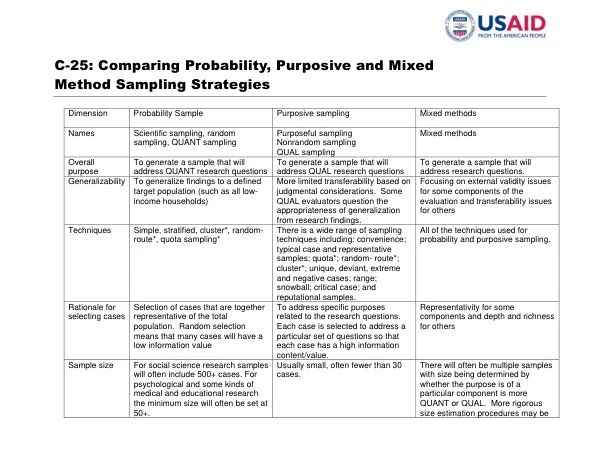
Comparing Probability, Purposive and Mixed Method Sampling Strategies
Probability sampling involves selecting a sample from a population using random methods to ensure representation.
2 pages
Sign in to readA free account is required to download.
Abstract
This approach is often used in quantitative research to generate a sample that will address research questions. The goal of probability sampling is to generalize findings to a defined target population, such as all low-income households. Techniques used for probability sampling include simple, stratified, cluster, random-route, and quota sampling. Probability sampling is often contrasted with purposive sampling, which involves selecting cases that are together representative of the total population. However, random selection means that many cases will have a low information value. Purposive sampling is often used in qualitative research to address specific purposes related to the research questions. Each case is selected to address a particular set of questions, resulting in a high information content/value. Sample size is a critical determinant in both probability and purposive sampling. For social science research, samples often include 500+ cases, while for psychological and some medical and educational research, the minimum size is often set at 50+. Purposive samples are usually small, often fewer than 30 cases. The size of the sample is determined by whether the purpose is of a particular component is more quantitative or qualitative. The overall sampling strategy must be developed with different subsamples being generated from it. It is essential to ensure that procedures ensure the different samples are comparable. A formal sampling frame covering the whole population of interest is often used for probability sampling, while judgmental sampling is used for purposive sampling. The sampling frame may be a list of families registered with an agency or a master sampling frame from which different sub-samples are generated. The depth/breadth of information per unit is a critical consideration in sampling. Probability sampling focuses on breadth of information and the ability to provide estimates for the total population of interest, while purposive sampling focuses on depth of information. Combining depth and breadth is often necessary to achieve the research goals. The sample is often selected before data collection begins, but sub-samples may be identified as the analysis evolves.