USAID DEC
Professional Skills Development Course for Women in the Energy Sector
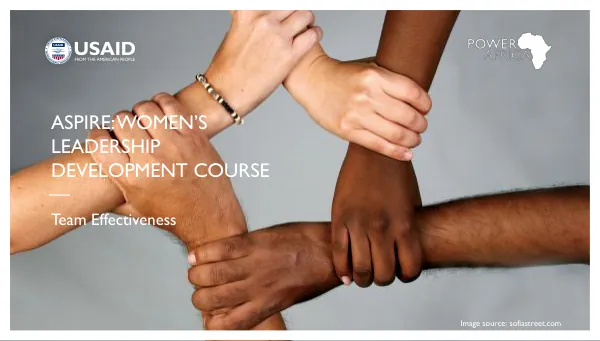
The ASPIRE: Women's Leadership Development Course focuses on team effectiveness, emphasizing the importance of understanding individual roles within an organization.
2022 · 27 pages
Sign in to readA free account is required to download.
Abstract
Team effectiveness is defined as the capacity a team has to accomplish the goals or objectives assigned to it by a person in authority or the organization. Organizations that work in teams recognize the significance of each individual's role in achieving overall success and economic viability. A working team is a unit of an organization, comprising departments such as Human Resources, Marketing, and Finance. Multi-functional and cross-functional teams are also mentioned, which involve collaboration among various departments to achieve specific objectives. Self-directed teams, special-purpose teams, and management teams are other types of teams discussed in the context of team effectiveness. The concept of team effectiveness is further reinforced by the quote "A chain is only as strong as its weakest link." This metaphor highlights the importance of each team member's contribution to the overall success of the team. The course aims to equip participants with a deeper understanding of what a team is, how teams are structured and operate, and how to motivate people to work together. The learning objectives of the module include gaining a deeper understanding of what a team is, demonstrating the different ways teams are structured and operate, learning how to motivate people to work together, and developing some team strengths and identifying and addressing some weaknesses. The course outline covers various topics, including team building dynamics, types of teams, team motivators and drivers, working with people, identifying strengths and addressing weaknesses, and collaboration rather than competition. To facilitate learning, the course includes a welcome activity, a cocktail introduction, and breakout rooms where participants can interact with each other. The facilitator provides guidance on ground rules for online participation, including showing one's face, muting the mic when not speaking, and using reaction icons and the chat to provide feedback and ask questions. The course also includes handouts, such as the Team Stages exercise and a blank sheet of paper and pen, to support participant engagement and learning.
Related documents