USAID DEC
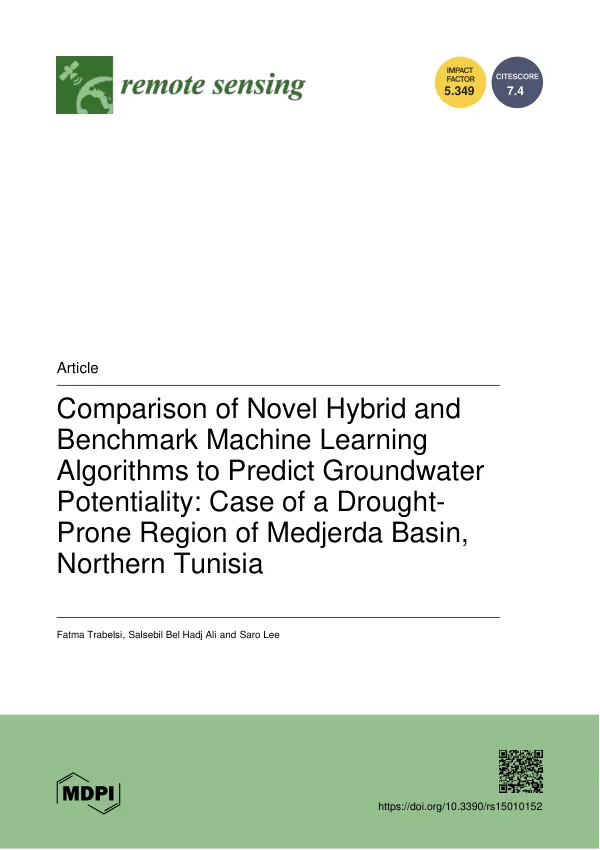
Comparison of Novel Hybrid and Benchmark Machine Learning Algorithms to Predict Groundwater Potentiality: Case of a Drought-Prone Region of Medjerda Basin, Northern Tunisia
Sign inUSAID DEC
Comparison of Novel Hybrid and Benchmark Machine Learning Algorithms to Predict Groundwater Potentiality: Case of a Drought-Prone Region of Medjerda Basin, Northern Tunisia
Groundwater potentiality is a critical concern in drought-prone regions, particularly in the Medjerda Basin of Northern Tunisia.
2023 · 31 pages
Sign in to readA free account is required to download.
Abstract
The region is characterized by water scarcity, mainly due to ineffective agricultural techniques, extensive groundwater abstraction, and inadequate water governance and management strategies. Effective water-resources management is crucial, and it is possible once there is an adequate understanding of available resources and reserves. The identification of groundwater potential zones is essential for water management strategies and will enable decision makers to manage land-use planning. The groundwater potential map (GPM) is a spatial distribution of potential groundwater recharge zones where groundwater occurrences are likely to be distributed according to topographic, geologic, hydrologic, hydrogeologic, and anthropogenic factors. The interactions of several groundwater conditioning factors such as groundwater occurrence and flow, net recharge, permeability and transmissivity, lithology, geological structures, lineaments and faults, geomorphology, topography, land slope, drainage regime, precipitation, land use and land cover (LULC), water quality, and water depth, among others, are used to estimate groundwater productivity potential. Reliable prediction models and appropriate conditioning parameters are crucial for precise GPMs. In this respect, the robustness of the GPM model is significantly impacted by the relevant datasets, the model used, and the scale of the study area. Given the development of geographic information systems (GIS), remote sensing, and data mining algorithms, numerous GPMs have been developed for different regions of the world. However, single machine learning (ML) models have several disadvantages such as slower learning speed, overfitting, and complex model structure. To overcome these limitations, researchers have integrated more than one base classifier and produced ensemble ML algorithms that can raise the performance and accuracy of the models. The use of hybrid ML models has been greatly enhanced, and they have recently become useful in calculating geohazard susceptibility and potentiality mapping. Various GPM studies have used ensemble methods such as the evidential belief function (EBF) and boosted regression tree (BRT), weights of evidence (WoE) and logistic regression (LR), and artificial neural network (ANN) and real AdaBoost (RAB). The present study aimed to develop a novel hybrid model, named NB-RF-SVR, to increase the accuracy of the groundwater potential predictive model. The naïve Bayes (NB) model is less sensitive to noise data, but it is considered a weak classifier when used individually. The random forest (RF) model is known as a robust ensemble model, but its single random sampling method allows for the random selection of negative samples, making it difficult to guarantee the generalization. The support vector regression (SVR) model is a powerful tool for regression tasks, but it requires careful tuning of its parameters. The study used 26 groundwater-related factors (GRF) selected by the frequency ratio model and 70% of the transmissivity training data as input for the models. The models' effectiveness was assessed using the AUC-ROC curve, sensitivity, specificity, mean absolute error (MAE), and root mean square error (RMSE) metric indicators. The validation findings revealed that all the models performed successfully for the GWPZ mapping, where the AUC values for the ANN, RF, SVR, and NB-RF-SVR models were estimated as 71%, 79%, 87%, and 92%, respectively. The relative importance of the GWPZs revealed that land use followed by geology and elevation were the most important factors. The outcomes of this study can provide valuable information for decision makers to effectively manage groundwater in water-stressed regions. The novel hybrid model, NB-RF-SVR, showed the highest accuracy of groundwater potential prediction, and its performance was superior to the single ML models. The study highlights the importance of developing new methods and models to improve the accuracy of groundwater potential prediction.
Related documents