USAID DEC
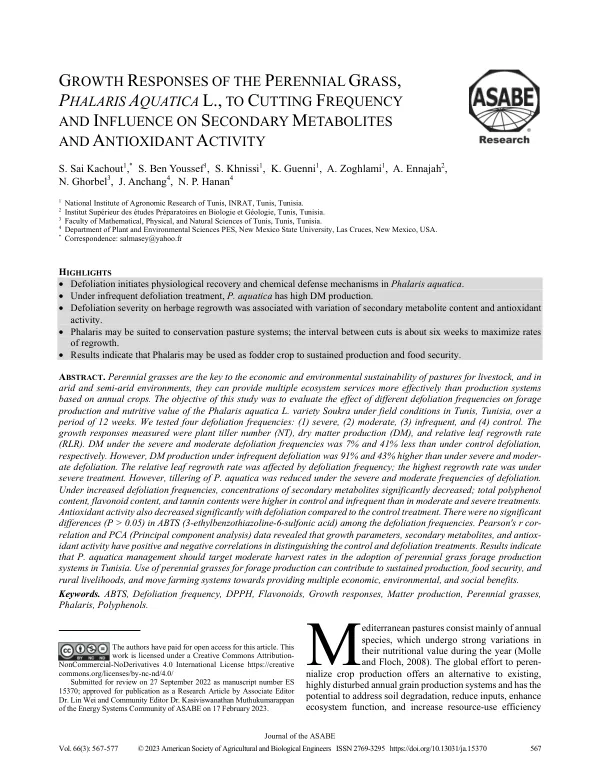
Growth Responses of the Perennial Grass, Phalaris Aquatica L., to Cutting Frequency and Influence on Secondary Metabolites and Antioxidant Activity
Sign inUSAID DEC
Growth Responses of the Perennial Grass, Phalaris Aquatica L., to Cutting Frequency and Influence on Secondary Metabolites and Antioxidant Activity
Perennial grasses, such as Phalaris aquatica L., are key to the economic and environmental sustainability of pastures for livestock.
2023 · 11 pages
Sign in to readA free account is required to download.
Abstract
In arid and semi-arid environments, they can provide multiple ecosystem services more effectively than production systems based on annual crops. The objective of this study was to evaluate the effect of different defoliation frequencies on forage production and nutritive value of the Phalaris aquatica L. variety Soukra under field conditions in Tunis, Tunisia, over a period of 12 weeks. Four defoliation frequencies were tested: severe, moderate, infrequent, and control. The growth responses measured were plant tiller number (NT), dry matter production (DM), and relative leaf regrowth rate (RLR). Dry matter production under severe and moderate defoliation frequencies was 7% and 41% less than under control defoliation, respectively. However, dry matter production under infrequent defoliation was 91% and 43% higher than under severe and moderate defoliation. The relative leaf regrowth rate was affected by defoliation frequency, with the highest regrowth rate under severe treatment. However, tillering of P. aquatica was reduced under severe and moderate frequencies of defoliation. Concentrations of secondary metabolites significantly decreased under increased defoliation frequencies. Total polyphenol content, flavonoid content, and tannin contents were higher in control and infrequent than in moderate and severe treatments. Antioxidant activity also decreased significantly with defoliation compared to the control treatment. There were no significant differences in ABTS (3-ethylbenzothiazoline-6-sulfonic acid) among the defoliation frequencies. Pearson's r correlation and PCA (Principal component analysis) data revealed that growth parameters, secondary metabolites, and antioxidant activity have positive and negative correlations in distinguishing the control and defoliation treatments. Phalaris aquatica management should target moderate harvest rates in the adoption of perennial grass forage production systems in Tunisia. Perennial grasses, such as Phalaris, are drought-resistant crops and have recently been attracting growing interest due to their extensive environmental benefits. They can contribute to improved soil structure and water retention capacity while also providing climate mitigation and adaptation services that promote biodiversity and ecosystem functions. Perennial grasses are considered an ideal source of bioenergy and bioproducts, and their use can contribute to sustained production, food security, and rural livelihoods. Phalaris aquatica L. is a perennial cool season herbaceous plant, known by the common names bulbous canary grass or harding grass, native to the Mediterranean area. It has been used for forage breeding programs due to its high biomass yield potential and drought tolerance. Phalaris is one of the most important sown perennial grasses, valued for its high productivity and ability to survive drought. It displays high productivity throughout the cooler seasons, and nutritive quality comparable to other temperate grasses during this period. Early harvesting increases the "greenness" of perennial grasses, thus increasing the potential suitability for anaerobic digestion, owing to lower C/N ratio, lignification, and higher protein content.
Related documents
Documents in this collection
 2023
2023USAID DEC
Effects of Date Palm Waste Compost Application on Root Proteome Changes of Barley (Hordeum vulgare L.)
Open record 2023
2023USAID DEC