DEMOCRACY INTERNATIONAL, INC.
Complexity-Aware Monitoring and Evaluation Vol. III, Issue 6 – September 2020
The Program of Alliances for Reconciliation (PAR) has implemented a strategy to prevent xenophobia toward Venezuelan migrants in Colombia.
2020 · 10 pages
Sign in to readA free account is required to download.
Abstract
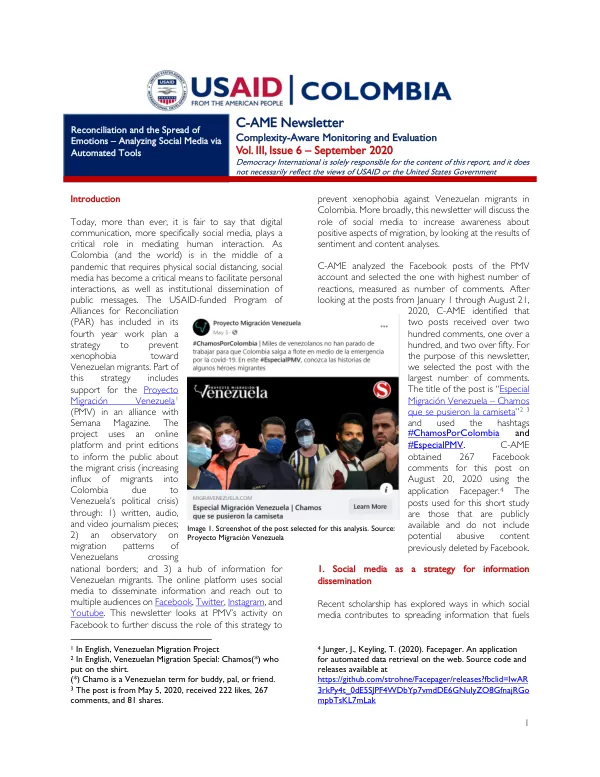
As part of this strategy, the Proyecto Migración Venezuela (PMV) has partnered with Semana Magazine to disseminate information about the migrant crisis through an online platform and print editions. The project uses written, audio, and video journalism pieces, as well as an observatory on migration patterns of Venezuelans crossing national borders, and a hub of information for Venezuelan migrants. The online platform uses social media to disseminate information and reach out to multiple audiences on Facebook, Twitter, Instagram, and Youtube. A post from May 5, 2020, titled "Especial Migración Venezuela – Chamos que se pusieron la camiseta" received 222 likes, 267 comments, and 81 shares. This post was selected for analysis by C-AME, a research organization, to examine the role of social media in preventing xenophobia against Venezuelan migrants in Colombia. Sentiment analysis was conducted on the comments received for this post using two different tools: the "sentiment-analysis-spanish" Python library and the sentiment analysis tool available in NVivo 12. The results of the sentiment analysis indicate that a significant proportion of comments have a negative sentiment, with 75% of comments responding to the post having negative (39%) and neutral (36%) sentiments, according to the "sentiment-analysis-spanish" tool. The NVivo sentiment analysis tool also found that 83% of comments correspond to negative and neutral sentiment, with 64% falling under the neutral category. The results of the sentiment analysis suggest that the Facebook post from PMV has received a significant proportion of comments with a negative sentiment. However, a random selection of 20 comments labeled as "neutral" showed that many of them contained negative language or sentiments. This highlights the complexity of sentiment analysis and the need for careful interpretation of results. The PMV project aims to change negative attitudes toward Venezuelan migrants in Colombia by disseminating the positive aspects of migration through different media and social media outlets. The project's use of social media analytics to understand the sentiment of comments and posts can help inform its strategy and improve its effectiveness in preventing xenophobia. The project's geographic focus is on Colombia, where Venezuelan migrants are arriving due to the political crisis in Venezuela. The project's timeframes are not specified, but it is part of the fourth year work plan of the PAR program. The project's recommendations are not explicitly stated, but the use of social media analytics and sentiment analysis can help inform the development of effective strategies to prevent xenophobia and promote positive attitudes toward Venezuelan migrants in Colombia. The project's implementation details include the use of an online platform and print editions to disseminate information about the migrant crisis. The project also uses social media to reach out to multiple audiences and to disseminate information about the positive aspects of migration. The project's methodology includes the use of sentiment analysis and content analysis to understand the sentiment of comments and posts. The project's findings suggest that social media can be a powerful tool for disseminating information and promoting positive attitudes toward Venezuelan migrants in Colombia. However, the results of the sentiment analysis also highlight the complexity of sentiment analysis and the need for careful interpretation of results. The project's recommendations are not explicitly stated, but the use of social media analytics and sentiment analysis can help inform the development of effective strategies to prevent xenophobia and promote positive attitudes toward Venezuelan migrants in Colombia.