USAID
Composting: A Squiggly New Venture
Composting is a key component of sustainable agriculture, and a new venture in Afghanistan is poised to provide an organic substitute for chemical fertilizer while promoting environmental sustainability and creating jobs for women.
2014 · 1 pages
Sign in to readA free account is required to download.
Abstract
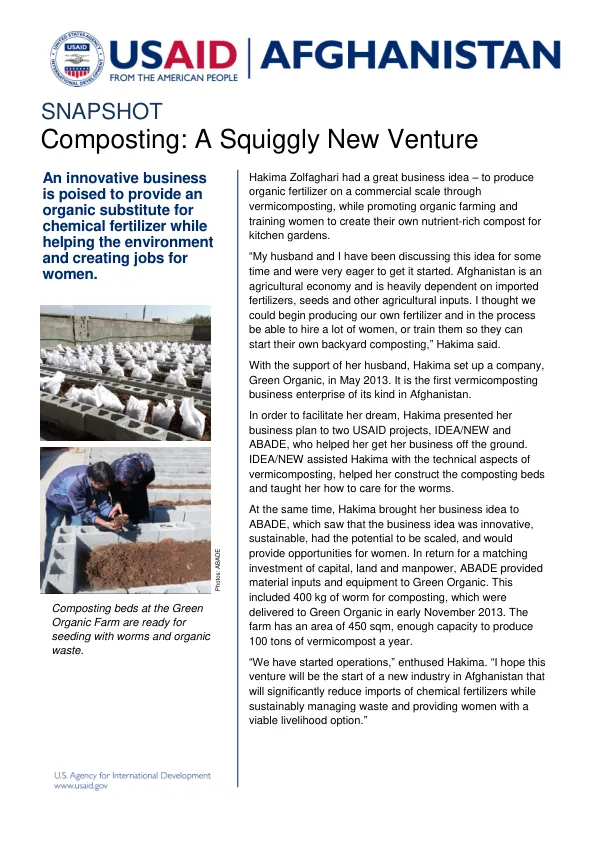
The Green Organic Farm, established in May 2013, is the first vermicomposting business enterprise of its kind in Afghanistan. Hakima Zolfaghari, the founder of Green Organic, had a vision to produce organic fertilizer on a commercial scale through vermicomposting, while promoting organic farming and training women to create their own nutrient-rich compost for kitchen gardens. The business plan for Green Organic was presented to two USAID projects, IDEA/NEW and ABADE, who provided support to facilitate the venture. IDEA/NEW assisted with the technical aspects of vermicomposting, including the construction of composting beds and training on worm care. ABADE, on the other hand, saw the potential for the business to be scaled and provided material inputs and equipment, including 400 kg of worms for composting. The farm has an area of 450 sqm, sufficient capacity to produce 100 tons of vermicompost per year. The Green Organic Farm has started operations, with Hakima expressing enthusiasm for the venture's potential to reduce imports of chemical fertilizers while sustainably managing waste and providing women with a viable livelihood option. The farm's focus on vermicomposting is a significant step towards promoting sustainable agriculture practices in Afghanistan, where the agricultural economy is heavily dependent on imported fertilizers, seeds, and other agricultural inputs. The establishment of Green Organic is also a testament to the potential for women's empowerment through entrepreneurship. Hakima's vision for the business was to hire and train women to create their own nutrient-rich compost for kitchen gardens, providing them with a viable livelihood option. The farm's operations are expected to create jobs for women, contributing to the country's efforts to promote women's economic empowerment. The success of Green Organic is also expected to have a positive impact on the environment. By reducing the use of chemical fertilizers, the farm will help to minimize the environmental harm caused by these substances. Additionally, the farm's focus on vermicomposting will help to manage waste sustainably, reducing the amount of organic waste that ends up in landfills. Overall, the Green Organic Farm is a significant development in Afghanistan's efforts to promote sustainable agriculture and women's economic empowerment.