USAID DEC
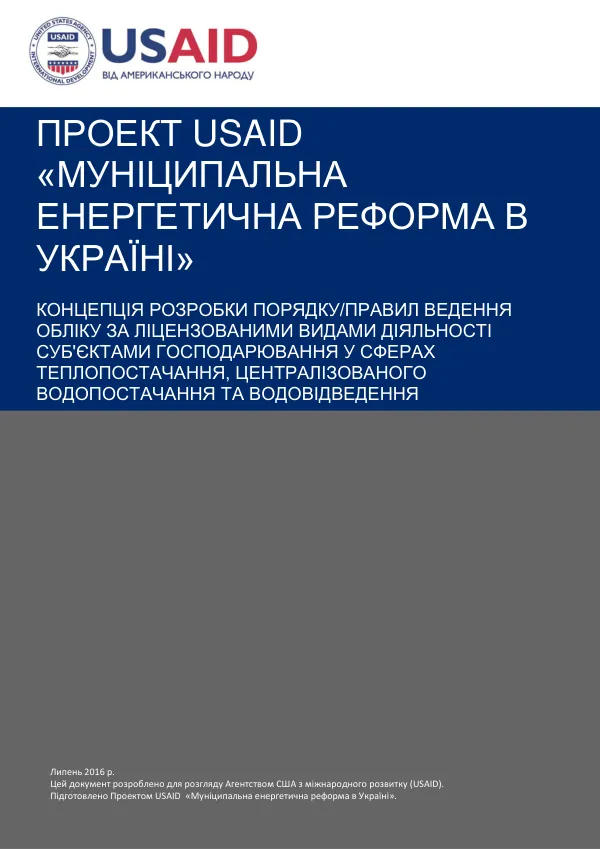
Concept for Development of the Procedure/Rules for Regulatory Accounting by Licensed Type of Activity by Entities Operating in the Heating and Centralized Water Supply and Sanitation Sectors
Sign inUSAID
Concept for Development of the Procedure/Rules for Regulatory Accounting by Licensed Type of Activity by Entities Operating in the Heating and Centralized Water Supply and Sanitation Sectors
The Concept for development of the Procedure/Rules for regulatory accounting by licensed type of activity by entities operating in the heating and centralized water supply and sanitation sectors was prepared by MDI in the framework of implementation of item 3.3 of the Work Plan of cooperation between the USAID Municipal Energy Reform in Ukraine Project and National Energy and Utilities Regulation Commission (NECSRC) signed on December 28, 2015.
2016 · 24 pages
Sign in to readA free account is required to download.
Abstract
The task was to develop the Methodological recommendations on accounting by licensed type of activity and to ensure that licensees of the NECSRC, as stipulated in Law “On Natural Monopolies”, fulfill the requirements regarding separate accounting by each type of activity that is subject to licensing. The Project and the NECSRC came to the conclusion that the Regulator’s requirements to licensees in the heating and centralized water supply and sanitation sectors regarding financial and other information are somehow different from the requirements to data provided for financial accounting purposes. This means that not all indicators and results required by the NECSRC are reflected in accounting records and confirmed by basic documents. Fulfillment of some regulatory requirements provides for application of methodologies, algorithms, calculations and breakdown which are the regulatory accounting tools. Considering the above, the Project and the NECSRC took the joint decision to develop the Procedure/Rules for accounting by licensed types of activities by entities operating in the heating, and centralized water supply and sanitation sectors (further – Accounting Procedure/Rules by licensed types of activity) where the Regulator’s requirements to specificities about accounting by licensed types of activities will be described with the help of the regulatory accounting sub-system, formulated clearly and explicitly, and unified. The Concept consists of four chapters. Chapter 1 discusses the goal of the Concept, its objectives, and background on separate accounting. Chapter 2 presents the results of the analysis of current legislative environment and discusses the importance of accounting by licensed type of activity. The requirement regarding separate accounting by each type of activity that is subject to licensing was set in legislation for natural monopolies and entities operating in adjacent markets starting from 2000 and can be found in other legislative acts. Chapter 3 focuses on the definition of “accounting by licensed type of activity”, discusses its key components and arguments why it is important. The comparative analysis of specific differences between financial accounting and regulatory (management) accounting was completed to develop on substance of accounting by licensed type of activity. Chapter 3 also presents the results of the analysis of international practices, in particular, the summary on normative regulation for regulatory accounting by licensed type of activity in the heating sector and specific overviews for Bulgaria, Kosovo, Kazakhstan, Republic of Lithuania. Given that accounting by licensed type of activity was first introduced in the energy sector which from the regulatory perspective is very close to district heating and centralized water supply and sanitation sectors, the Concept briefly presents the description of relevant European energy laws which determine the trend regarding expansion of separate accounting practices and discusses the reasons and objectives which call forth the necessity to introduce accounting by licensed type of activity. Chapter 4 presents the proposals on the further steps regarding separate accounting by type of licensed activity: rough structure and contents of Procedure/Rules for accounting by licensed types of activities, terms of completion of the task, other measures for improvement of the regulatory system of the communal sector, which are planned to be implemented in parallel, possible risks and measures to mitigate them.