USAID DEC
Conflicts in Mbinga-Nord, DRC: Invisible Factors and Possibilities for Transformation
Sign inINTERNATIONAL ALERT
Conflicts in Mbinga-Nord, DRC: Invisible Factors and Possibilities for Transformation
The study conducted in Mbinga-Nord groupement, Kalehe territory, South Kivu province, Democratic Republic of the Congo, analyzed six large-scale conflicts that remain a major concern in villages within the area.
2018 · 45 pages
Sign in to readA free account is required to download.
Abstract
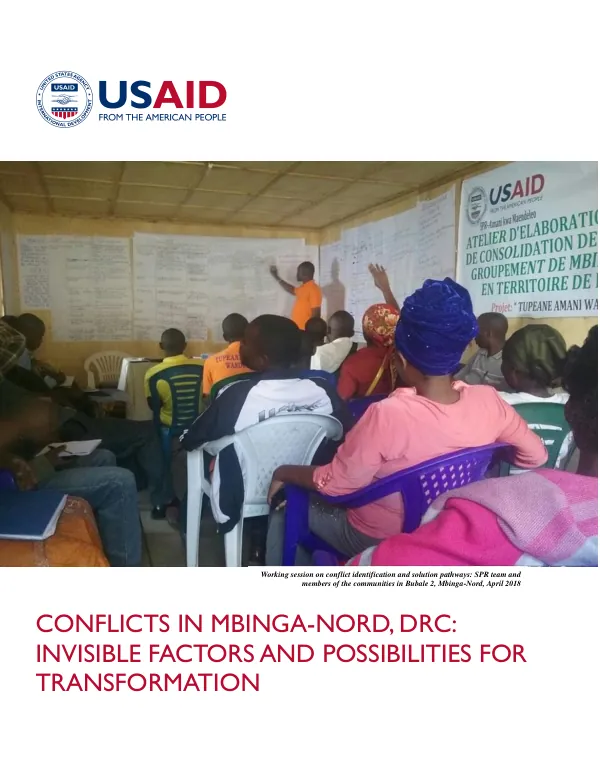
The study was conducted with a view to supporting the peacebuilding, social, and recovery strategy for the project under joint implementation by the consortium comprising Management Systems International (MSI, the prime), International Alert (IA), and the International Rescue Committee (IRC). This USAID-funded project contributes to strengthening the foundations of sustainable peace and preventing recurrent conflicts. Inclusion of women and other marginalized groups through peacebuilding initiatives in North Kivu and South Kivu are a key component to the project's success. Mbinga-Nord is one of the areas in Kalehe territory that has been affected by multiple and multiform conflicts over the course of several decades. The analysis process involved document reviews and interviews with International Alert partners, local peace and development committee members, community leaders, politico-administrative authorities, and civil society actors from five localités in Mbinga-Nord groupement. Analysis of findings resulted in the prioritization of six conflicts out of the 47 identified in this area. These conflicts include: * A land conflict between livestock farmers and crop farmers * A dispute between large-scale landowners and small-scale landowners * A conflict concerning the supply of drinking water, between the inhabitants of the localité of Bubale 1 and the NGO "EST" * A conflict between coffee growers and the agricultural cooperatives * Conflicts between the civil society and state-supported services * Conflicts between the mine operators and mining concessionaries The study found that the conflicts in Mbinga-Nord have been multiple and multiform over several decades. Land conflicts are rooted in problems between individual family members (questioning inheritance rights), large-scale landowners and small-scale landowners, crop farmers and livestock farmers, buyers of plantations and local populations, and mining concessionaries and cooperatives. Economic conflicts originate from conflicts between coffee growers and agricultural cooperatives, crop farmers and livestock farmers. Conflicts over power occur between the village chief and youth, and between local authorities and security services. Social conflicts are taking place between the civil society and the state-supported services. The study prioritized six conflicts out of the 47 identified in the area, and a seventh priority was identified following further analysis, citing its scale within the communities in question. The study's findings highlight the need for a comprehensive approach to address the root causes of these conflicts and to promote peacebuilding, social cohesion, and recovery in the region.
Related documents