USAID DEC
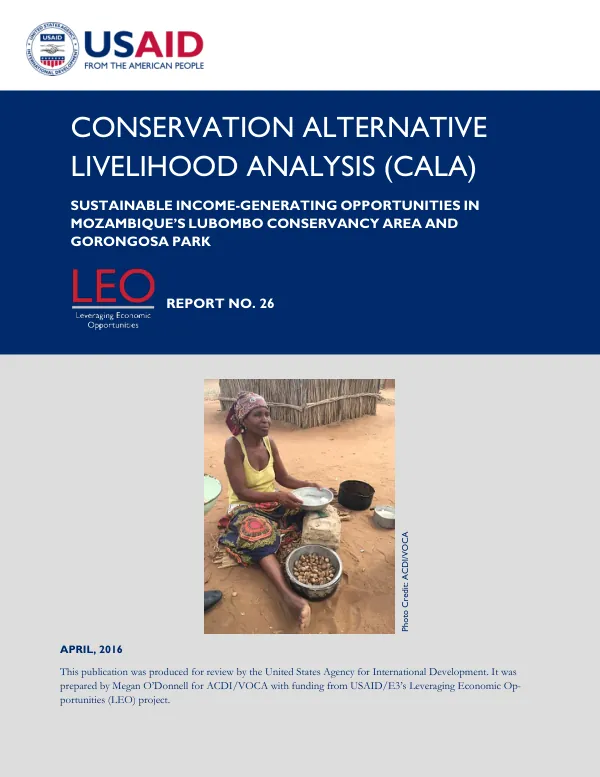
Conservation Alternative Livelihood Analysis (CALA): Sustainable Income-Generating Opportunities in Mozambique's Lubombo Conservancy Area and Gorongosa Park
Sign inACDI/VOCA
Conservation Alternative Livelihood Analysis (CALA): Sustainable Income-Generating Opportunities in Mozambique's Lubombo Conservancy Area and Gorongosa Park
The Lubombo Conservancy Area and Gorongosa Park in Mozambique are emerging tourism destinations, experiencing a revival after decades of civil war.
2016 · 64 pages
Sign in to readA free account is required to download.
Abstract
Blessed with valuable natural resources and stunning wildlife, these areas are attracting tourism investors and conservationists. However, local populations rely largely on low-value subsistence agriculture and unsustainable exploitation of nature to survive, including poaching of endangered species and overfishing. This puts them in direct conflict with tourism developers and conservationists who are looking to preserve and replenish the natural environment. Wildlife crimes are challenging conservation goals and tourism development in these two regions of Mozambique. The illegal wildlife trade is estimated to be worth over $10 billion per year and has drastically reduced many wildlife populations around the world. The growing demand for endangered species parts, such as rhino horns or elephant ivory, has raised prices astronomically, up to $600,000 reportedly for one average-sized rhinoceros horn. Global syndicates are entering wildlife areas to source these valuable supplies, contracting local populations to expertly track animals and offering them prize sums that are luring villagers to join the poaching trade. To address these challenges, a livelihood analysis was conducted to identify income-generating opportunities that can disincentivize local communities from participating in poaching activities. The analysis selected four livelihoods in each region as the focus for intervention, based on four key criteria: income opportunity, scale of population impacted, improved conservation, and competitiveness of the local offering. The selected livelihoods for Lubombo leverage existing natural resources while taking into account basic economic conditions and socio-cultural factors. The four key livelihoods in Lubombo are cattle, fresh vegetables, Marula and medicinal plants, and tourism. Opportunities exist to improve the cattle livelihood source by investing in livestock production and services, improved market linkages, and local meat processing capacity. Fresh vegetables are a higher-value product that can be sold locally or to traders at more stable prices with assistance in improving agricultural practices, market information, and linkages. Marula and medicinal plants have marketing potential as a table snack, traditional medicine, wine, and animal feed supplement, with potential opportunities identified for both domestic and export markets. The nascent tourism industry will bring new investment, jobs, and business opportunities for local people, but immediate challenges in terms of natural resources should be addressed to ensure that communities and tourism development can co-prosper. The selected livelihoods for Gorongosa Park are honey, maize, fruit/dried fruit, and tourism. Honey is a valuable product that can be harvested sustainably, providing income opportunities for local communities. Maize is a staple crop that can be improved through better agricultural practices and market linkages. Fruit/dried fruit has marketing potential as a high-value product, with opportunities identified for both domestic and export markets. The tourism industry in Gorongosa Park presents a possible end market for these products, as well as new investment, jobs, and business opportunities for local people. A strategy of enforcement, education, and awareness, among other tools, must be deployed as a primary driver to reduce poaching. Creating income opportunities and accompanying economic development will be just one of the tools to fight poaching. The value chain analyses performed as part of this study were of a first screening nature, and additional analysis will be essential to inform future program design and interventions.
Related documents