RTI INTERNATIONAL
Conservation Value Chain Analysis in Priority Areas of Connectivity
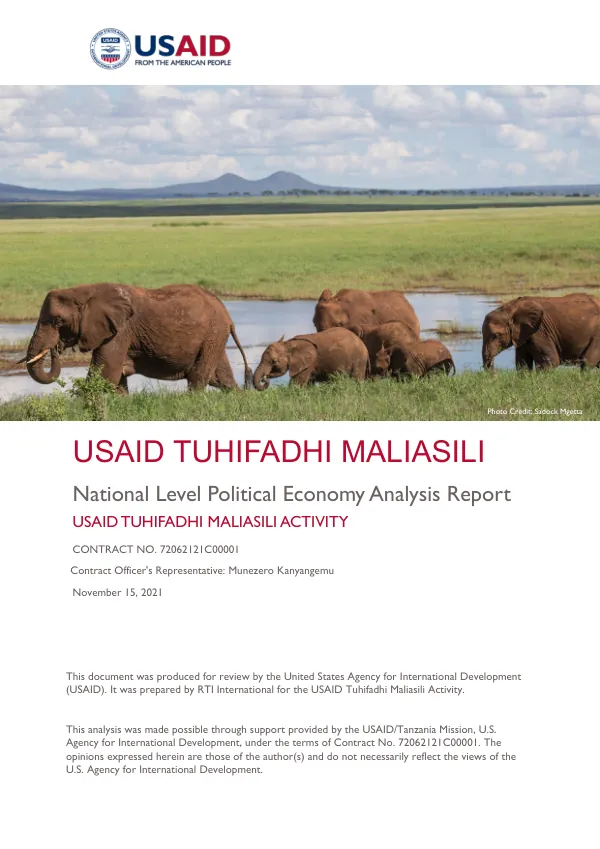
The conservation value chain analysis in Tanzania was conducted by USAID Tuhifadhi Maliasili (TM) Activity staff to understand existing conservation-based opportunities and/or enterprises in the TM priority areas of connectivity.
2021 · 42 pages
Sign in to readA free account is required to download.
Abstract
The analysis focused on six priority areas: Kwakuchinja, Tarangire-Simanjiro, Nyerere Selous-Udzungwa, Kigosi Moyowosi-Uvinza, Amani-Nilo, and Pemba Channel Conservation Area (PECCA). The aim was to map out market linkages and bottlenecks, evaluate market shifts due to COVID-19, and identify opportunities for increased participation of women and youth in conservation-based enterprises. The analysis covered six key conservation value chains: tourism (ecotourism), beekeeping (honey and honey products), seaweed farming/aquaculture, fishing, spice farming, and butterfly farming. Data was obtained through online and offline sources, including online meetings and phone interviews with key stakeholders from the public and private sectors. Guiding questions were provided beforehand to ensure respondents were prepared and could actively engage during the conversations. Findings from the analysis indicate that conservation value chains in Tanzania are not uniformly distributed and equally developed. The tourism value chain is well-established, with ecotourism being a significant contributor to the country's economy. However, the beekeeping value chain faces challenges related to market access and competition from imported honey products. Seaweed farming/aquaculture has potential for growth, but is hindered by limited market access and high production costs. The fishing value chain is also facing challenges, including overfishing and lack of effective management. Spice farming has shown promise, with opportunities for increased production and export. Butterfly farming is a relatively new industry in Tanzania, but has potential for growth and income generation. The analysis highlights the need for increased participation of women and youth in conservation-based enterprises, particularly in the beekeeping and seaweed farming/aquaculture value chains. Private investment and partnership opportunities have also been identified, particularly in the tourism and spice farming value chains. The conservation value chain analysis provides valuable insights into the opportunities and challenges facing conservation-based enterprises in Tanzania. The findings can inform policy and programming decisions, and support the development of sustainable conservation-based enterprises that benefit local communities and contribute to the country's economic growth. The Kwakuchinja Corridor is a priority area for conservation efforts, with a focus on ecotourism and honey value chains. The Tarangire-Simanjiro Dispersal Area is another priority area, with a focus on ecotourism and wildlife conservation. The Nyerere Selous-Udzungwa Corridor is a critical area for conservation, with a focus on ecotourism, honey value chains, and wildlife conservation. The Kigosi Moyowosi-Uvinza Corridor is a priority area for conservation efforts, with a focus on ecotourism and honey value chains. The Amani-Nilo Corridor is another priority area, with a focus on ecotourism, butterfly farming, and spice value chains. The Pemba Channel Conservation Area (PECCA) is a critical area for conservation, with a focus on ecotourism, seaweed value chains, and fishing. The analysis highlights the need for effective management and regulation of the fishing value chain, including measures to prevent overfishing and promote sustainable fishing practices. The conservation value chain analysis provides valuable insights into the opportunities and challenges facing conservation-based enterprises in Tanzania, and can inform policy and programming decisions to support the development of sustainable conservation-based enterprises.
Related documents