USAID DEC
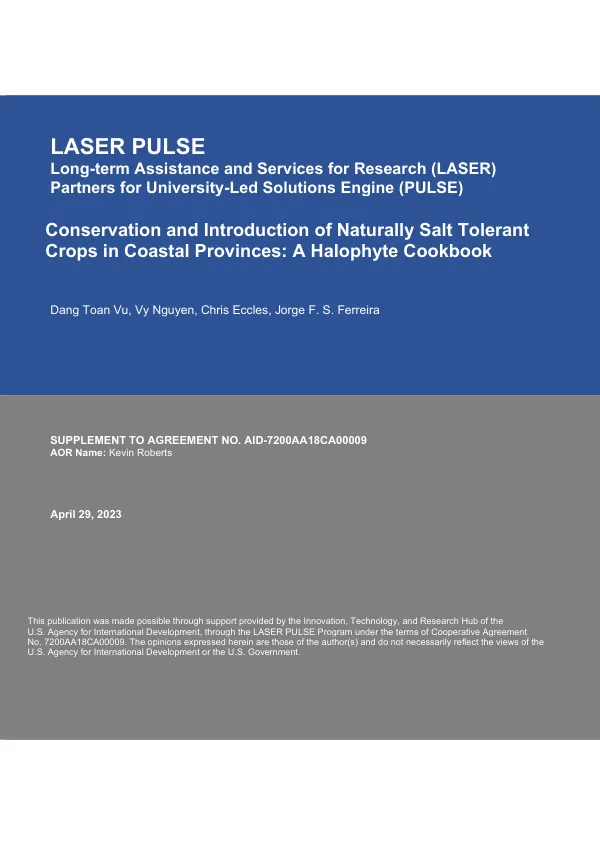
Conservation and Introduction of Naturally Salt Tolerant Crops in Coastal Provinces: A Halophyte Cookbook
Sign inCATHOLIC RELIEF SERVICES ORGANIZATION
Conservation and Introduction of Naturally Salt Tolerant Crops in Coastal Provinces: A Halophyte Cookbook
The agricultural development initiative in coastal provinces of Vietnam focuses on the conservation and introduction of naturally salt-tolerant crops, also known as halophytes.
2023 · 18 pages
Sign in to readA free account is required to download.
Abstract
This project aims to develop incentives for farmers to invest in pollution control measures that conserve freshwater resources, enhance the productivity of underutilized crops with natural tolerance to high salinities, and reduce the discharge of untreated water into public water bodies. The project targets coastal farmers who are vulnerable to the effects of climate change. The introduction of naturally salt-tolerant crops is expected to enhance the genetic diversity of crops produced by coastal farmers, building resilience among agricultural communities. The project also aims to provide clear and practical uses for the crops included in the research program through a cookbook. The cookbook, titled "Conservation and Introduction of Naturally Salt-Tolerant Crops in Coastal Provinces: A Halophyte Cookbook," provides recipes based on three halophyte species: Suaeda maritima, Portulaca oleracea, and Chenopodium album. The recipes include salads, stir-fries, and soups that incorporate the halophyte species into common dishes in Vietnam and other areas of Southeast Asia. The project is implemented by a consortium led by the Plant Resource Center, Vietnam Academy for Agricultural Sciences, in collaboration with Seawater Solutions and the Agricultural Water Efficiency and Salinity Research Unit/US Salinity Laboratory (USDA-ARS). The project is funded through the LASER PULSE Program, a five-year, $70M program funded through USAID's Innovation, Technology, and Research Hub. The project's objectives are to develop incentives for farmers to invest in pollution control measures, enhance the productivity of underutilized crops, and reduce the discharge of untreated water into public water bodies. The project also aims to provide clear and practical uses for the crops included in the research program through the cookbook. The cookbook includes recipes for various dishes that incorporate the halophyte species. For example, the "Annual Sea-Blite Salad" recipe includes ingredients such as young parts of Suaeda maritima, roasted peanuts, sugar, lime leaves, chili pepper, mung bean sprouts, and carrots. The recipe involves washing and soaking the sea-blite in water to reduce its natural salty taste, boiling the sea-blite, and then mixing it with other ingredients to create a salad. Another recipe, "Annual Sea Blite Salad with Dried Beef," includes ingredients such as annual sea-blite, dried beef, lime, chili pepper, groundnut, sugar, fish sauce, and spearmint. The recipe involves removing the roots of the sea-blite, washing and soaking it in water to reduce its natural salty taste, boiling the sea-blite, and then mixing it with other ingredients to create a salad. The project's implementation involves several steps, including the development of incentives for farmers to invest in pollution control measures, the enhancement of the productivity of underutilized crops, and the reduction of the discharge of untreated water into public water bodies. The project also involves the provision of clear and practical uses for the crops included in the research program through the cookbook. The project's geographic focus is on the coastal provinces of Vietnam, where the introduction of naturally salt-tolerant crops is expected to enhance the genetic diversity of crops produced by coastal farmers, building resilience among agricultural communities. The project's timeframes are not specified, but the cookbook is dated April 29, 2023, indicating that the project is ongoing.