USAID
Conservation Enterprises Learning Group: What We Have Learned
Establishing enduring conservation enterprises requires several enabling conditions.
2021 · 3 pages
Sign in to readA free account is required to download.
Abstract
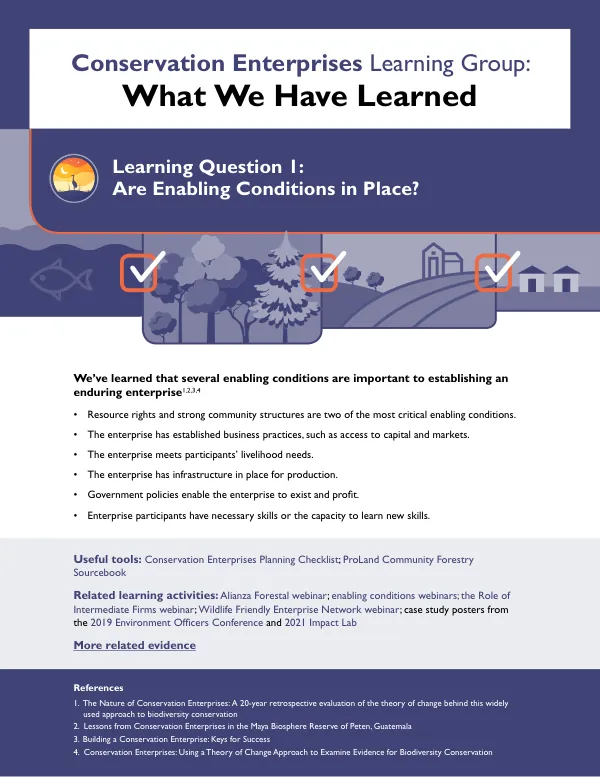
Resource rights and strong community structures are critical components, as they provide a foundation for the enterprise's success. Business practices, such as access to capital and markets, are also essential. The enterprise must meet participants' livelihood needs, have infrastructure in place for production, and operate within a supportive policy environment. Additionally, enterprise participants must possess necessary skills or have the capacity to learn new skills. Successful conservation enterprises provide stakeholders with benefits, which may include cash or non-cash incentives such as cultural value, food security, and improved education. Non-cash benefits, like education and healthcare, can have a positive impact on the broader community. Tying benefits to conservation status can improve the likelihood of behavior change, but it is essential to understand that different stakeholders are motivated by different incentives. Research suggests that about half of conservation enterprises are able to motivate behavior change. Conservation enterprises are most effective when combined with other strategic approaches. Securing land tenure, improving enforcement capacity, and mitigating human-wildlife conflict can complement enterprise approaches and ensure sustainable results. However, few studies have evaluated the direct impacts of conservation enterprises on conservation outcomes, highlighting a gap in monitoring and evaluation. The Conservation Enterprises Learning Group emphasizes the importance of using a theory of change approach to examine evidence for biodiversity conservation. The Conservation Enterprises Planning Checklist and ProLand Community Forestry Sourcebook are useful tools for establishing conservation enterprises. Related learning activities, such as the Alianza Forestal webinar and enabling conditions webinars, provide additional insights into the topic. The MEL Framework for Conservation Enterprises and Biodiversity How-to Guide on the Conservation Standards are also valuable resources for conservation enterprise development. Research has shown that conservation enterprises can have a positive impact on biodiversity conservation when implemented effectively. However, the success of these enterprises depends on various factors, including the presence of enabling conditions, the provision of benefits to stakeholders, and the combination of enterprise approaches with other strategic initiatives. By understanding these factors, conservation practitioners can develop effective conservation enterprise strategies that promote biodiversity conservation and sustainable development.