GOVERNMENT OF GHANA
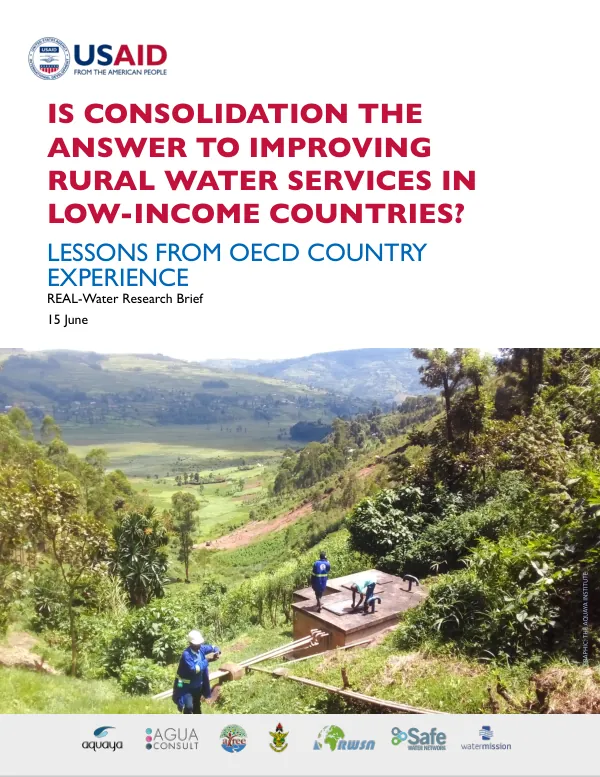
Consolidation of Rural Water Services: An Emerging Trend Toward Economies of Scale
The ambitious targets set out in Sustainable Development Goal (SDG) 6.1 for 2030 have established a high bar for expanding safely managed rural water services.
2023 · 11 pages
Sign in to readA free account is required to download.
Abstract
As of 2020, 83 out of 99 countries covered by the Joint Monitoring Programme (JMP) of the World Health Organization and UNICEF were not on track to achieve SDG 6.1, and only 60% of the global rural population had access to safely managed services. Community-based management (CBM) emerged from the UN International Drinking Water and Sanitation Decade ending in 1990, relying heavily on 'self-sustaining' community involvement and financing. Despite improvements in rural access rates to water services during the period from 2000 to 2020, most studies point toward poor CBM performance, particularly for unsupported CBM in low-income countries. The financial challenges facing CBM are often notable, with levels of tariff payment generally insufficient to support direct operating costs. However, exceptions to these findings exist where specific conditions enable better performance, including deep boreholes in the context of freshwater scarcity and piped supplies on premises. In cases where there is adequate long-term support and significant investment, either from public sources or development assistance, the community management model can perform well. These conditions are more common in middle-income countries, such as Morocco, Brazil, Peru, and Indonesia, where the donor and government-funded PAMSIMAS program has yielded high rates of sustained functionality. Considering the shortcomings of CBM, many governments in low- and lower-middle-income countries are introducing and testing alternative management arrangements for rural water service provision. New sector policies and changes to regulatory frameworks have allowed the adoption of both public utility and private operator models, which have achieved different levels of scale. Globally, this points to a trajectory away from the unsupported CBM approaches towards more formalized and more formally regulated alternatives that aim to deliver higher levels of service. It is equally the case that CBM will not disappear overnight, nor will the need to rely upon communities for some portion of the organization and delivery of water services. One of the emerging approaches pursued by low- and lower-middle-income countries is to group together rural water supply schemes into larger service areas or to expand an existing service provider's responsibility across multiple service areas. This approach aims to achieve economies of scale, increase the revenue base, reduce overhead costs, and limit exposure by pooling the risks of infrastructure failure. Examples of consolidation of rural water provision in Africa include Benin, Ghana, Rwanda, Senegal, Uganda, and Zambia, where private operators or public utilities have been established to manage rural water services. The literature on expansion of management arrangements to achieve economies of scale, more professionalized service provision, and lowering operational costs includes multiple terms with varying definitions. The two most widely used terms are "consolidation" and "aggregation," but "regionalization," "clustering," or "bundling" are also found. Consolidation occurs when two or more separate legal entities become a single entity operating under the same governance, management, and financial functions. Aggregation refers to the creation of new dedicated rural operators by expanding the umbrella of management to incorporate physically separate schemes or by expanding existing urban utilities by extending physical (piped) networks into contiguous rural areas.