USAID DEC
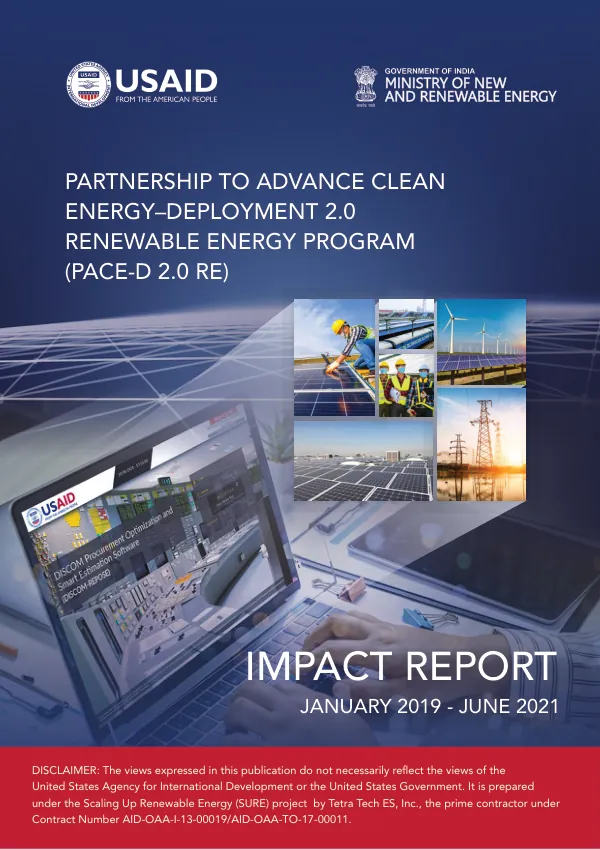
Impact Report 2019-2021: Partnership to Advance Clean Energy–Deployment 2.0 Renewable Energy Program (PACE-D 2.0 RE)
Sign inTETRA TECH ESI, INC.
Impact Report 2019-2021: Partnership to Advance Clean Energy–Deployment 2.0 Renewable Energy Program (PACE-D 2.0 RE)
The Partnership to Advance Clean Energy–Deployment 2.0 Renewable Energy (PACE-D 2.0 RE) program was implemented in partnership with the Indian Ministry of New and Renewable Energy (MNRE) to help national and state partners provide reliable, clean energy to consumers at an affordable price.
2021 · 24 pages
Sign in to readA free account is required to download.
Abstract
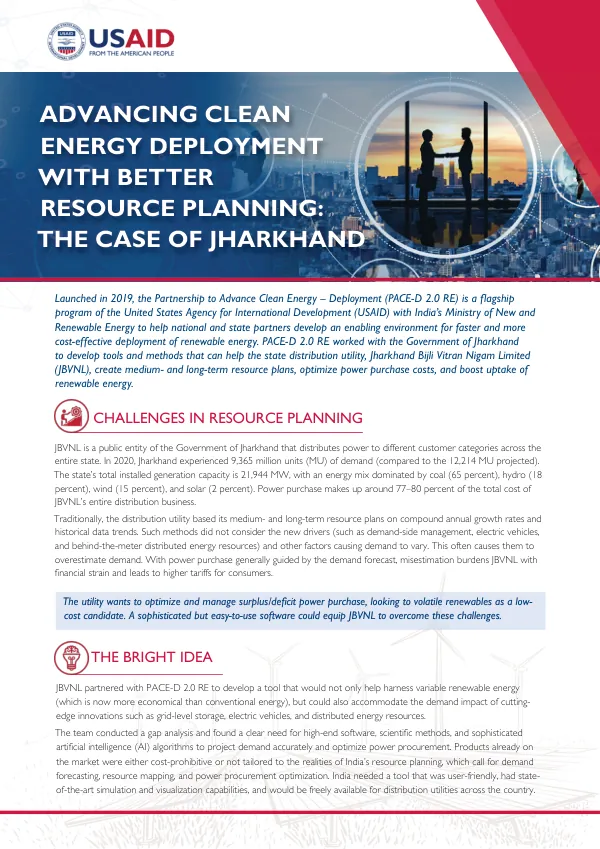
The program aimed to support India in achieving its goal of adding 175 GW of renewable energy by 2022 and 450 GW by 2030. India's power sector has undergone significant transformation in the last decade, with power generation capacity doubling from 132.33 gigawatts (GW) in 2007 to 370 GW in 2020. The sector still faces several challenges, including increasing energy demand and fossil fuel imports, poor financial condition of power distribution companies (DISCOMs), and air pollution. To address these challenges, the Government of India has set a renewable energy (RE) target of 175 GW by 2022, including 40 GW of solar rooftop energy by 2022, and aims to achieve 450 GW by 2030. The PACE-D 2.0 RE program partnered with the states of Assam, Gujarat, and Jharkhand, Indian Railways, Solar Energy Corporation of India (SECI), Confederation of Indian Industry, Godrej Green Business Center (CII-GBC), and other agencies to improve strategic energy planning, scale grid-connected distributed renewable energy, and adopt innovative renewable energy procurement models. The program is part of the Scaling Up Renewable Energy (SURE) project, a global USAID program that helps partner countries enhance their energy security and open paths to self-reliance through competitive renewable energy markets. The PACE-D 2.0 RE program delivered several innovative and state-of-the-art solutions to enable achievement of RE targets in a reliable and cost-effective manner. One of the key solutions was the development of the DISCOM Renewable Procurement Optimization and Smart Estimation (REPOSE) software tool. REPOSE helps to accurately forecast mid- and long-term power demand, simulate various renewable energy scenarios, optimize costs, and provide mid-term and long-term renewable energy plans for utilities and states. DISCOMs in Assam, Jharkhand, Punjab, Orissa, and Karnataka states have successfully adopted and utilized this tool. Another key solution was the development of the Super RESCO model for deployment of solar rooftop with low-paying customers. The Super RESCO model aims to enhance the engagement of residential consumers in the solar rooftop journey and has the potential to save $800 million annually if 15 percent of residential power supplied to residential customers with high T&D losses comes from solar rooftops. PACE-D 2.0 RE partner state, Jharkhand, is piloting a 25 MW project using the Super RESCO business model. The program also introduced the concept of system-friendly procurement of renewable energy to reduce integration costs. The Solar Energy Corporation of India made use of the concept in procurement of 1.6 GW of RE power, and Indian Railways is planning to procure 150 MW under a program promoted round-the-clock power model. An analysis conducted with the REPOSE software suggests that innovative RE procurement, such as profile matching of RE and demand, can help DISCOMs increase RE use by 10 to 15 percent and reduce cost by 5 to 10 percent. The PACE-D 2.0 RE program worked with national and state-level partners to develop and adopt enabling policies, regulations, tools, and methodologies that would set up DISCOMs for success during and after the pandemic and help India achieve its renewable energy goals. Capacity-building efforts intensified with virtual webinars and professional trainings. The program also made efforts to scale its successful approaches across the South Asia region, launching an online certification program on strategic energy planning. Through two training programs, 123 utility professionals were trained, and efforts are underway to institutionalize the training program with a premier Indian technical institution. With support from PACE-D 2.0 RE, program partner states and institutions are better able to plan, finance, and implement innovative solutions that accelerate India's transition to a clean energy economy. DISCOMs are now more strategic, innovative, and efficient. They also have adopted more market-driven approaches to attract private sector investments in renewable energy technology. States are seeing an increase in private investment in the renewable energy market and are training the workforce in the skills needed to transition to the clean energy economy. Institutions are better equipped to respond to energy and climate challenges and support communities and individuals to have clean, lower-cost, and reliable electricity. The PACE-D 2.0 RE program has also worked on strategic energy planning, which determines when, where, and how to invest. Strategic energy planning helps predict consumers' electricity needs more accurately, makes renewable energy procurement more cost-effective, and matches electricity demand with the renewable resources leading to minimum system integration cost. The cost of purchasing power accounts for 60 to 70 percent of DISCOMs' total costs. Better, more strategic resource planning has the potential to reduce