TETRA TECH ESI, INC.
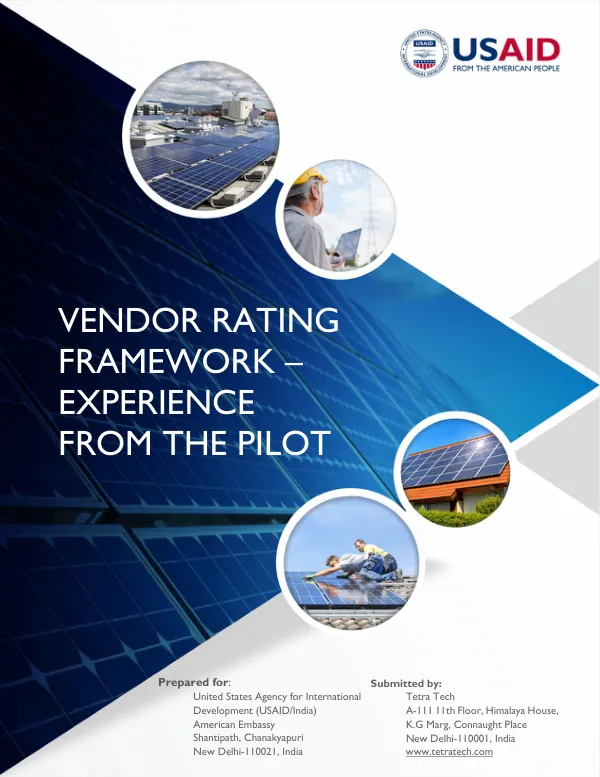
Vendor Rating Framework – Experience from the Pilot
The Vendor Rating Framework (VRF) is a tool developed by the MNRE-USAID Partnership to Advance Clean Energy Deployment PACE-D 2.0 RE Program, along with CII-Godrej Green Business Center (CII-Godrej GBC) and the National Renewable Energy Lab (NREL).
2021 · 22 pages
Sign in to readA free account is required to download.
Abstract
The framework aims to benchmark various rooftop solar (distributed solar) engineering, procurement and construction companies (EPCs or vendors) on a uniform set of parameters, providing a sense of the quality of the work carried out by these firms. The framework assesses companies on financial and technical capabilities and majorly on quality and safety of actual systems deployed on sites. The goal of developing this framework is to improve the quality of installations across the country and help customers and users make an informed choice of the vendors that they choose for their solar PV systems. Additionally, this framework will help identify improvement factors for various EPCs so that they may better the quality of their solar PV installations. Before the implementation of the Vendor Rating Framework (VRF) on a national scale, there was a need to test and evaluate the framework itself. GERMI supported the Program in implementing this pilot. This report provides details of the evaluation of the framework. The pilot test was carried out for 10 EPCs in the state of Gujarat. Five solar PV installations were selected for each EPC under the present assignment, bringing the total inspected sites to 50. The pilot test involved the selection of various sites and EPCs based on five parameters: geographic distribution, category of EPC (as per GEDA classification), type of installation, system capacity (kWp), and overall experience in SPV installations. A total of 50 sites totaling to 2,120 kWp (1,890 kWp non-residential plus 230 kWp residential) of solar PV installations were inspected by the five inspection teams, which completed all 50 site inspections in 15 days. The Vendor Rating Framework (VRF) collects information and documents them through two checklists: (i) site inspection checklist, and (ii) technical & financial evaluation checklist. The parameters included in the site inspection checklist have a total weightage of 70 marks, and the parameters included in the technical & financial evaluation checklist have a total weightage of 30 marks. There are nine categories in the site inspection checklist, which provide insights to the major quality and safety issues as revealed in the PACE-D 2.0 RE program's earlier report. The report presents the assessment of marks obtained by the participating EPCs with respect to system size, district of installation, and categories of the evaluation checklist. Some of the key learnings from this pilot are highlighted below: * A deviation in the average rating of EPCs was observed, indicating a need for improvement in quality and safety standards. * The site inspection checklist revealed major quality and safety issues, including incomplete documentation, inadequate testing, and poor installation practices. * The technical & financial evaluation checklist highlighted the need for improvement in financial and technical capabilities, including inadequate financial reporting and poor technical expertise. * The pilot test demonstrated the effectiveness of the Vendor Rating Framework (VRF) in assessing the quality and safety of solar PV installations. * The framework has the potential to improve the quality of installations across the country and help customers and users make an informed choice of the vendors that they choose for their solar PV systems. The pilot test was carried out in the state of Gujarat, and the results are expected to be applicable to other states as well. The Vendor Rating Framework (VRF) is expected to be implemented on a national scale, and the results of this pilot test will be used to refine and improve the framework.