BANK FOR WEST AFRICAN DEVELOPMENT
Control of Neglected Tropical Diseases Program
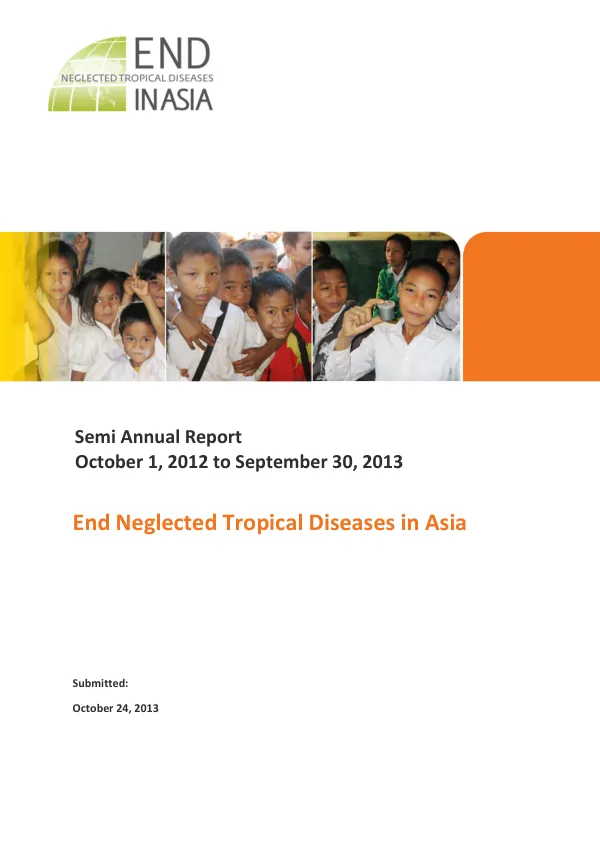
The National NTD Control Program in Vietnam has made excellent use of the support provided under the End Neglected Tropical Diseases in Asia (END in Asia) program managed by Family Health International (FHI 360).
2012 · 16 pages
Sign in to readA free account is required to download.
Abstract
Implementation in Vietnam, the Philippines, and the Philippines, and Cambodia commenced on October 1, 2012, based on the approved Collaborative Workplan for each country, and proceeded on schedule and within budget throughout this reporting period. In both Bangladesh and Vietnam, "umbrella" subagreements were executed on October 28, 2011, with the respective National NTD Programs. These subagreements identify the specific Activity/Milestones from the Collaborative Workplans to be implemented by the National NTD Program and set the cost for each. During this reporting period, eleven Fixed Obligation Grants (FOGs) were issued for Vietnam, and two FOGs were issued for Bangladesh. This funding mechanism has been working extremely well, with all parties enjoying the simple and efficient administrative process. In the Philippines, FHI 360 acts as the fiscal agent and provides direct funding and financial support for all END in Asia activities, while the National NTD Program remains responsible for organization and implementation of program activities. FHI 360 has hired a full-time Finance Officer to manage program finances, who works in collaboration with the National NTD Program staff. All activities continue to be effectively implemented as outlined in their Collaborative Workplan. A corresponding Supplemental Initial Environmental Examination (SIEE) has been prepared for Cambodia based on the activities outlined in the Collaborative Workplan and submitted to USAID for review and approval. The SIEE includes an Environmental Monitoring and Mitigation Plan and a template for an Environmental Monitoring Report, which will be completed annually and submitted to the project Agreements Officer Representative (AOR). The coverage and treatment results of the END in Asia supported Mass Drug Administration for Soil Transmitted Helminthes for School Age Children in Vietnam, which was implemented from November 2011 to January 2012, were officially reported to USAID in March 2012 using the standard MDA reporting format. However, it now appears that the results may need to be reported using a special format. The Project Director attended a USAID NTD Meeting in Washington DC from December 19 to 20, 2011, and has been involved in numerous conference calls with the NTD team at USAID Washington to continually strengthen coordination and maintain effective communications. Implementation of END in Asia activities during this reporting period included: Vietnam: The National Institute of Malariology, Parasitology and Entomology, MOH (NIMPE) organized a Contact and Treatment for Lymphatic Filariasis (LF) in Song Bung village, Khanh Hoa province from November 7 to 11, 2011. ICT tests were administered to 300 individuals who lived in the vicinity of the one child found to be positive for LF during the previous Survey in January 2011. Two positive cases were found, and therefore the entire community will be provided with treatment. Prevalence remains well below the WHO criteria, and there is no need to reestablish Mass Drug Administration in the area. An Organization Meeting was implemented on March 28, 2012, to prepare for the upcoming Transmission Surveys in Thai Binh province. The meeting aimed to discuss the implementation of the surveys, including the selection of survey sites, the training of survey teams, and the logistics of the surveys. The National NTD Control Program in the Philippines has also made significant progress in implementing END in Asia activities. The program has implemented a series of activities, including the organization of a National Stakeholder Meeting in February 2012, which brought together representatives from the National NTD Control Program, the Department of Health, and other stakeholders to discuss the implementation of the program and the Collaborative Workplan. The program has also implemented a series of activities to support the implementation of the program, including the organization of a series of training sessions for the National NTD Control Program staff, the procurement of equipment and supplies, and the implementation of a series of surveys to assess the prevalence of NTDs in the country. The END in Asia program has made significant progress in implementing its activities in the four focus countries. The program has implemented a series of activities, including the organization of a series of National Stake
Related documents