USAID DEC
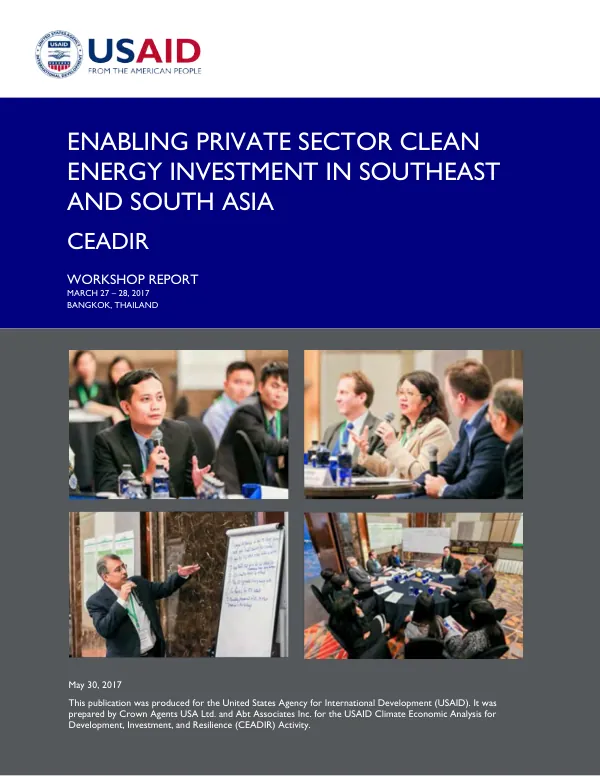
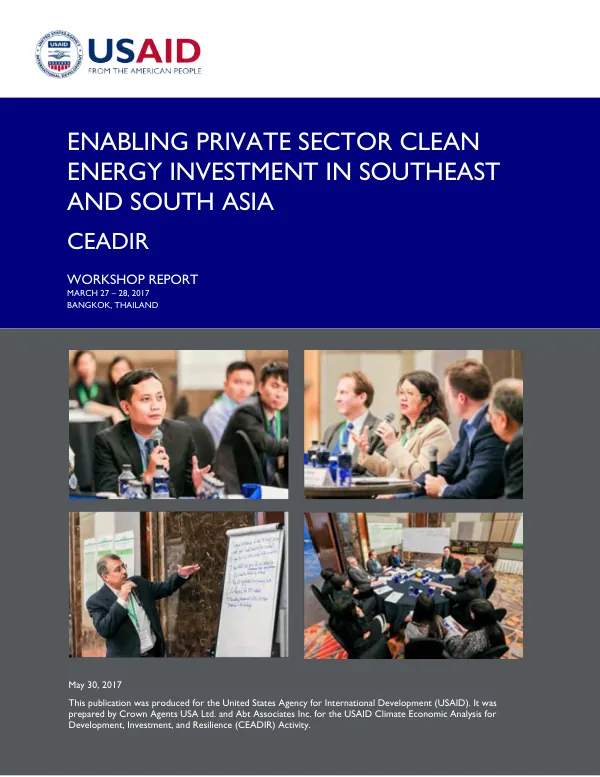
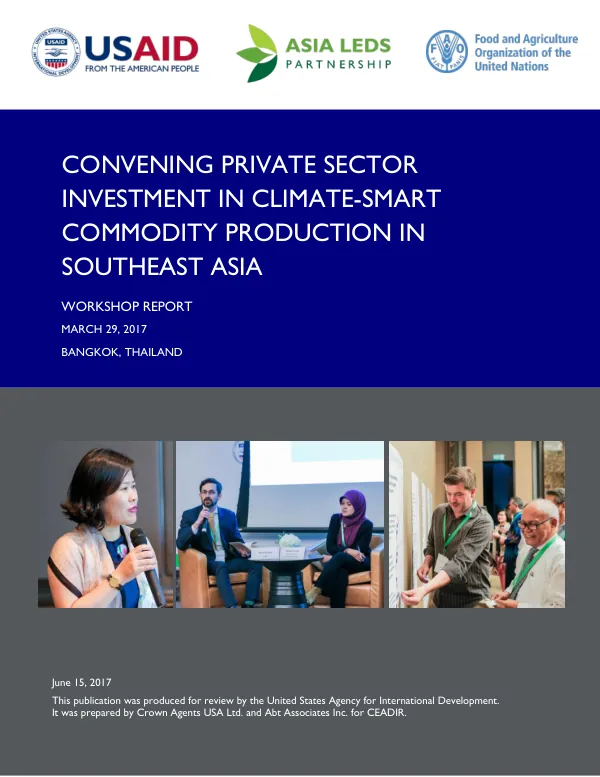
Convening Private Sector Investment in Climate-Smart Commodity Production in Southeast Asia: Workshop report
Sign inABT ASSOCIATES
Convening Private Sector Investment in Climate-Smart Commodity Production in Southeast Asia: Workshop report
The workshop on convening private sector investment in climate-smart commodity production in Southeast Asia was held on March 29, 2017, in Bangkok, Thailand.
2017 · 48 pages
Sign in to readA free account is required to download.
Abstract
The event brought together over 100 participants from the private sector, governments, and international organizations to discuss opportunities and challenges in scaling up climate-smart agriculture and forestry commodity production in the region. The workshop aimed to align agribusiness and climate action, with a focus on investments and challenges from private sector commitments. Keynote speakers and panelists highlighted the importance of climate-smart agriculture and forestry in reducing greenhouse gas emissions and promoting sustainable development in Southeast Asia. Climate-smart financing for scale and impact was a major theme of the workshop, with discussions on innovative financing mechanisms and instruments that can support climate-smart agriculture and forestry investments. Southeast Asian governments also shared their commitments and priorities for climate action, including the implementation of Nationally Determined Contributions (NDCs) under the Paris Agreement. Commercial certification was identified as a key tool for scaling verifiable impact in climate-smart agriculture and forestry. The workshop explored the role of certification schemes, such as the Forest Stewardship Council (FSC), in promoting sustainable forest management and reducing deforestation. Increasing scale and impact in climate-smart agriculture and forestry was a major priority for the workshop, with discussions on strategies for scaling up climate-smart agriculture and forestry practices, including the use of data and monitoring systems to track progress and identify areas for improvement. Data gaps were also identified as a major challenge in climate-smart agriculture and forestry, with discussions on the need for better data and monitoring systems to understand the risks, rewards, and opportunities associated with climate-smart agriculture and forestry investments. Reducing risks and increasing profitability of byproduct use and waste reduction was another key theme of the workshop, with discussions on strategies for reducing waste and increasing the value of byproducts in climate-smart agriculture and forestry. The workshop also explored the role of consumer climate action in promoting sustainable agriculture and forestry practices, with discussions on strategies for engaging consumers and promoting climate-smart agriculture and forestry products. Key challenges and priorities for future action were identified during the workshop, including the need for improved data and monitoring systems, increased investment in climate-smart agriculture and forestry, and enhanced collaboration among stakeholders to promote sustainable development in Southeast Asia. The workshop concluded with a call to action for governments, private sector companies, and international organizations to work together to promote climate-smart agriculture and forestry practices in Southeast Asia. The report highlights the importance of convening private sector investment in climate-smart commodity production in Southeast Asia and provides recommendations for future action. The workshop was co-sponsored by the Climate Economic Analysis for Development, Investment, and Resilience (CEADIR) activity, the Food and Agriculture Organization of the United Nations (FAO), the Asia Low Emission Development Strategies (LEDS) Partnership, and Control Union. The report was prepared by Crown Agents USA Ltd. and Abt Associates Inc. with contributions from Control Union and the Food and Agriculture Organization of the United Nations. The workshop participants included representatives from the private sector, governments, and international organizations, including the United States Agency for International Development (USAID), the Asian Development Bank (ADB), and the World Bank. The report highlights the importance of collaboration and coordination among stakeholders to promote sustainable development in Southeast Asia. The report provides a comprehensive overview of the workshop proceedings, including the key themes, discussions, and recommendations. It highlights the importance of climate-smart agriculture and forestry in reducing greenhouse gas emissions and promoting sustainable development in Southeast Asia. The report also provides an overview of the climate change mitigation targets as prescribed in Nationally Determined Contributions (NDCs) and the data gaps in rice, palm oil, and timber production value chains. It highlights the need for improved data and monitoring systems to understand the risks, rewards, and opportunities associated with climate-smart agriculture and forestry investments. The report concludes with a summary of the six priority actions of government and private sector by topic, including the need for improved data and monitoring systems, increased investment in climate-smart agriculture and forestry, and enhanced collaboration among stakeholders to promote sustainable development in Southeast Asia.