USAID DEC
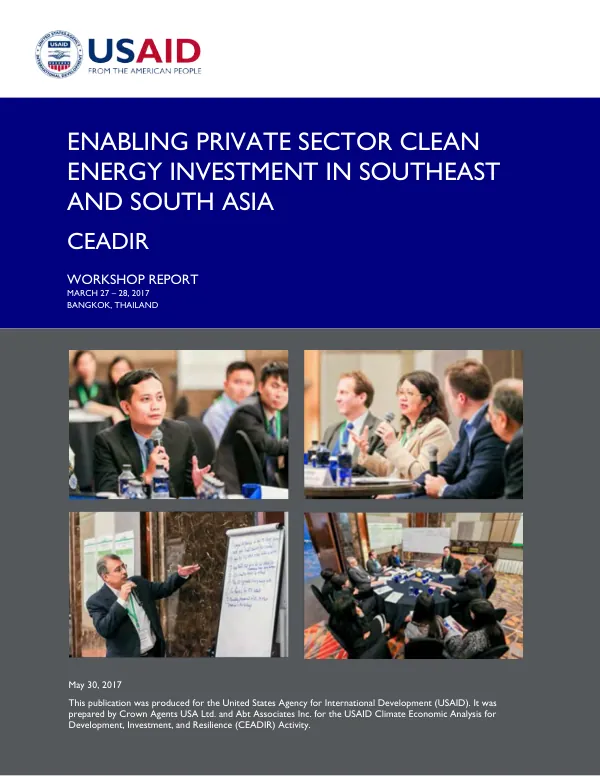
Enabling Private Sector Clean Energy Investment in Southeast and South Asia: Workshop Report
Sign inABT ASSOCIATES
Enabling Private Sector Clean Energy Investment in Southeast and South Asia: Workshop Report
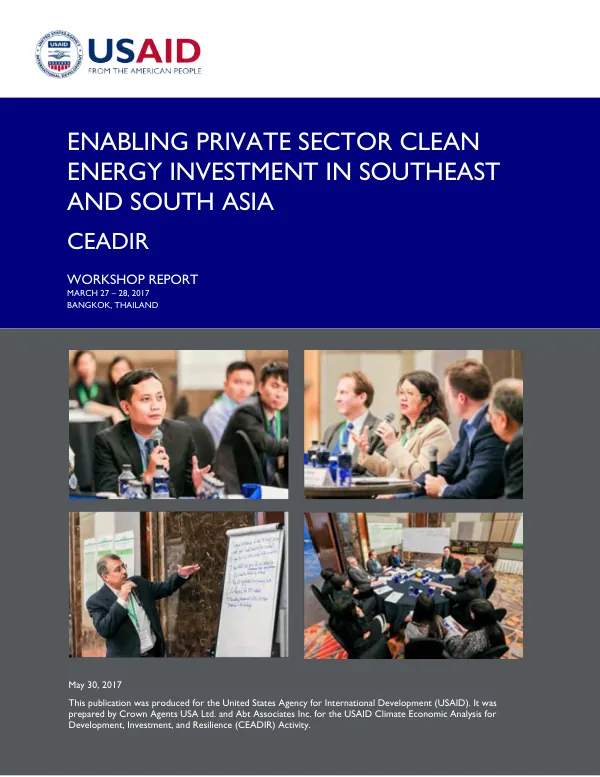
The workshop on enabling private sector clean energy investment in Southeast and South Asia was held in Bangkok, Thailand, from March 27-28, 2017.
2017 · 45 pages
Sign in to readA free account is required to download.
Abstract
The event was organized by the Climate Economic Analysis for Development, Investment, and Resilience (CEADIR) activity, which is supported by the United States Agency for International Development (USAID). The workshop aimed to facilitate peer-to-peer learning and knowledge sharing among public and private sector stakeholders to accelerate clean energy investment in the region. Country leadership was identified as a crucial factor in enabling private sector clean energy investment. Governments can play a key role in creating an enabling environment for clean energy investment by providing policy and regulatory support, as well as facilitating access to finance. The workshop highlighted the importance of country-specific actions to address barriers to increasing private sector investment in clean energy. For example, Indonesia has implemented a feed-in tariff (FIT) program to support the development of renewable energy projects, while the Philippines has established a renewable energy regulatory authority to oversee the industry. The workshop also emphasized the need for collaboration between public and private sector stakeholders to accelerate clean energy investment. Private sector leaders recommended priority collaborations, including the development of a clean energy investment accelerator and the establishment of a renewable energy buyers alliance. The workshop also highlighted the importance of tools and resources to increase clean energy investment, such as the Clean Energy Solutions Center and the Climate Policy Initiative. The workshop resulted in several key recommendations, including the development of country-specific action plans to address barriers to increasing private sector investment in clean energy. The recommendations also emphasized the need for continued collaboration between public and private sector stakeholders to accelerate clean energy investment in the region. The workshop was attended by representatives from government, private sector, and civil society organizations from Southeast and South Asia, as well as international experts and organizations. The workshop highlighted the importance of clean energy investment in achieving the region's climate change commitments. The Association of Southeast Asian Nations (ASEAN) has set a target of increasing the share of renewable energy in the region's energy mix to 23% by 2025. The workshop emphasized the need for continued support and investment in clean energy to achieve this target and to reduce greenhouse gas emissions in the region. The workshop also highlighted the importance of small and medium-sized enterprises (SMEs) in the clean energy sector. SMEs can play a key role in driving innovation and job creation in the sector, and they require access to finance and other forms of support to grow and develop. The workshop emphasized the need for continued support for SMEs in the clean energy sector to achieve the region's climate change commitments. The workshop was a key step in facilitating peer-to-peer learning and knowledge sharing among public and private sector stakeholders to accelerate clean energy investment in Southeast and South Asia. The recommendations and outcomes of the workshop will inform the development of country-specific action plans and the implementation of clean energy policies and programs in the region.