USAID DEC
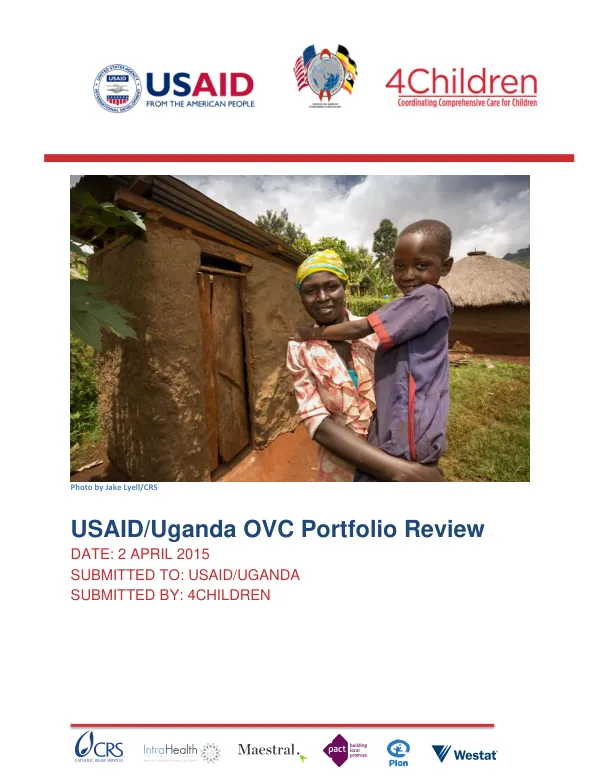
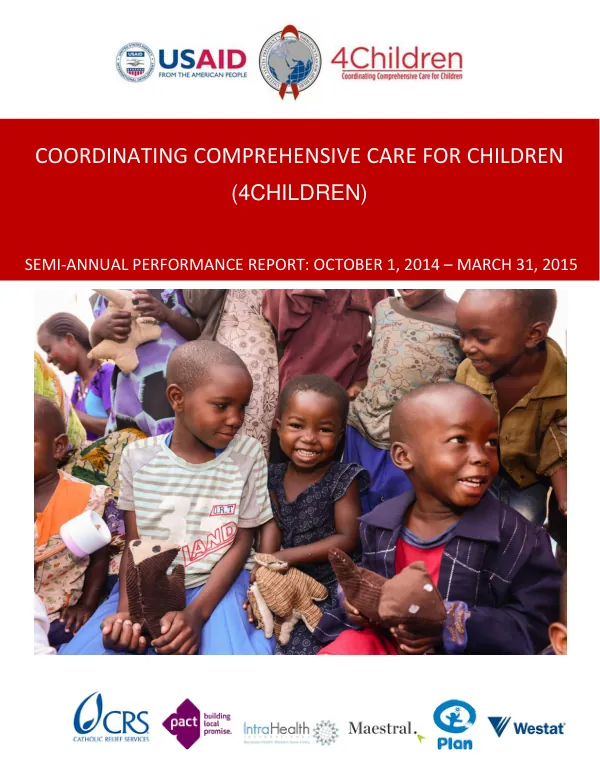
Coordinating Comprehensive Care for Children (4Children) Semi-Annual Performance Report: October 1, 2014 – March 31, 2015
Sign inCATHOLIC RELIEF SERVICES ORGANIZATION
Coordinating Comprehensive Care for Children (4Children) Semi-Annual Performance Report: October 1, 2014 – March 31, 2015
Coordinating Comprehensive Care for Children (4Children) is a five-year, USAID-funded project to assist orphans and vulnerable children (OVC) by building technical and organizational capacity, strengthening essential components of the social service system, and improving linkages with health and other sectors.
2015 · 22 pages
Sign in to readA free account is required to download.
Abstract
The project is implemented through a consortium led by Catholic Relief Services (CRS) with partners IntraHealth International, Pact, Plan International USA, Maestral International, and Westat. The objectives of 4Children are to increase the generation and use of evidence through surveillance and research to inform strategic child welfare and protection programming for children affected by AIDS and other adversities, to support countries to scale up evidence-based child welfare and protection programming, and to create an enabling environment, focused on local capacity and ownership, that is conducive to sustainable and quality child welfare and protection programming. 4Children began on September 15, 2014. During the first six months of implementation, the project has worked in close collaboration with USAID to complete a successful start-up phase and initiate a set of core activities and country-based activities. A full project team, including all Key Personnel, has been hired and began work. Financial tracking and reporting systems were established, and other operational procedures and guidance were developed. Sub-recipient agreements were approved and signed with all consortium partners, and a series of meetings to coordinate planning and activities were held with partners as well as with USAID. Project work on several "core" activities was initiated after defining the scope, objectives, and desired outputs of each. These activities include assisting MEASURE Evaluation to refine and field test a monitoring and evaluation framework for efforts to strengthen social service systems; identifying promising practices and developing programming guidance for integrating interventions to prevent and respond to violence against children, early childhood development, and mental health support into HIV/AIDS and OVC programming; developing case studies, tools, and procedures for improving case management and referral systems as part of OVC programs; supporting the Global Social Service Workforce Alliance; and managing the OVCsupport.net website as a platform for disseminating evidence, experience, and resources to improve programming. Among the core activities initiated, the project has made significant progress in strengthening social service system indicators, transitioning and managing OVCsupport.net, integrating violence against children prevention and response activities within PEPFAR programs, supporting the management and development of products through the Global Social Workforce Alliance, and supporting the integration of early childhood development within HIV/health platforms for children under 5 years. In addition to core activities, the project has also made progress in country-based activities, including keeping children in healthy and protective families in the Democratic Republic of Congo, Uganda portfolio review, and Democratic Republic of Congo social welfare system strengthening. The project has also made progress in gender inclusion, accomplishments against targets during the reporting period, challenges and lessons learned, upcoming activities and next steps, environmental compliance, human subjects protection, and program management. The project has established a full project team, including all Key Personnel, and has completed a successful start-up phase. Financial tracking and reporting systems have been established, and other operational procedures and guidance have been developed. Sub-recipient agreements have been approved and signed with all consortium partners, and a series of meetings to coordinate planning and activities have been held with partners as well as with USAID. Overall, the project has made significant progress in its first six months of implementation, and is well-positioned to achieve its objectives and make a positive impact on the lives of orphans and vulnerable children.
Related documents