USAID DEC
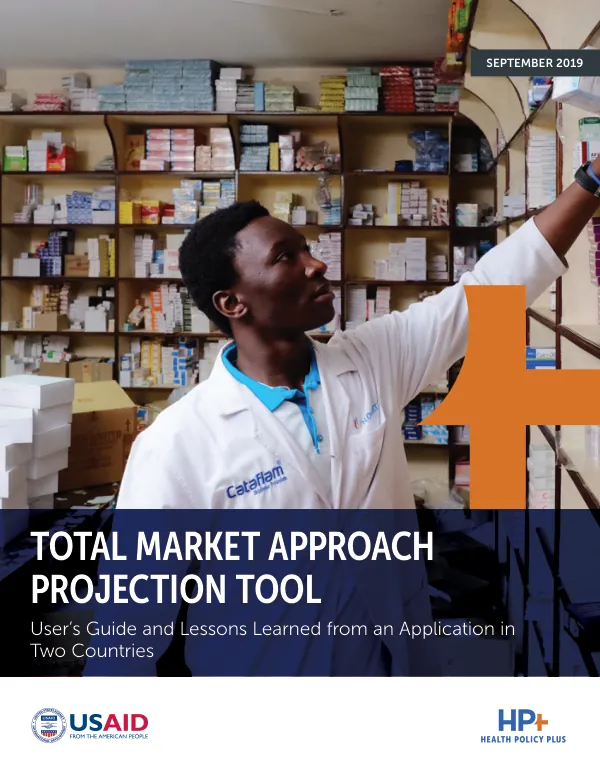
Total Market Approach Projection Tool: User’s Guide and Lessons Learned from an Application in Two Countries
Sign inAVENIR HEALTH
Total Market Approach Projection Tool: User’s Guide and Lessons Learned from an Application in Two Countries
The Total Market Approach (TMA) Projection Tool is an Excel-based tool that estimates the health and financial impacts of increased commercial sector investment in family planning.
2019 · 26 pages
Sign in to readA free account is required to download.
Abstract
Developed with the objective of improving policymakers' understanding of how shifts in market share among public, social marketing, and commercial players can lead to increased modern contraceptive prevalence rate (mCPR), equity, and sustainability of a country's family planning program. The tool estimates financial and health equity impacts at the country level if commercial family planning markets grow while free and subsidized resources are better targeted to those who lack the ability and/or willingness to pay for products and services. The model projects the increase in women served by the commercial sector if commercial products are more readily available, as well as the shift in commercial market share. The TMA Projection Tool allows a user to project the public and donor resources that are saved when a proportion of wealthier women shift from using family planning products that are subsidized by donors and government to using commercial family planning products. It then estimates the number of additional women that could be reached if those savings are invested in pro-poor outreach programs. With these outputs, the model helps policymakers envision the role of the commercial sector in achieving a more sustainable family planning market. The tool is most useful for countries working to reduce unmet need for family planning with market sustainability in mind. A country may be a good candidate for this tool if it has identified donor dependence as a threat to its family planning program and wants to actively take steps to address the issue. These steps might include recognizing the importance of the private commercial sector in policy documents, or, in a more advanced scenario, planning or implementing market interventions that are aligned with strategies. In countries where a level of buy-in for TMA exists among key decisionmakers, this tool can help policymakers to reinforce the case using evidence regarding the health and financial impacts of increased commercial sector involvement in family planning. The TMA Projection Tool comes pre-loaded with data from nine of the 24 USAID Family Planning Priority countries: Ethiopia, Haiti, Malawi, Nepal, Pakistan, the Philippines, Senegal, Tanzania, and Uganda. These countries were selected based on recent data availability and the need for evidence-based decision-making in family planning programming. The tool's user's guide and insights from applications in Uganda and Nepal serve to help users set up, implement, and interpret the tool and its outputs effectively to drive policy and market-level interventions in a given country. The tool's key user assumptions include the assumption that commercial sector growth will lead to increased access and equity to family planning products and services. The model also assumes that the commercial sector will serve a different role than the public and social marketing sectors, providing products and services priced at various levels to serve those who have the ability to pay. The tool's model application and results to date have shown that the TMA Projection Tool can help policymakers envision the role of the commercial sector in achieving a more sustainable family planning market. The tool's country-specific model application has been demonstrated in Uganda and Nepal. In Uganda, the model showed that increased commercial sector involvement in family planning could lead to a 27% increase in modern contraceptive prevalence rate (mCPR) among women of reproductive age (WRA). In Nepal, the model showed that increased commercial sector involvement in family planning could lead to a 15% increase in mCPR among WRA. The tool's insights from these applications have served to help users set up, implement, and interpret the tool and its outputs effectively to drive policy and market-level interventions in a given country.