BANK FOR WEST AFRICAN DEVELOPMENT
U.S. Coral Triangle Initiative Support Program
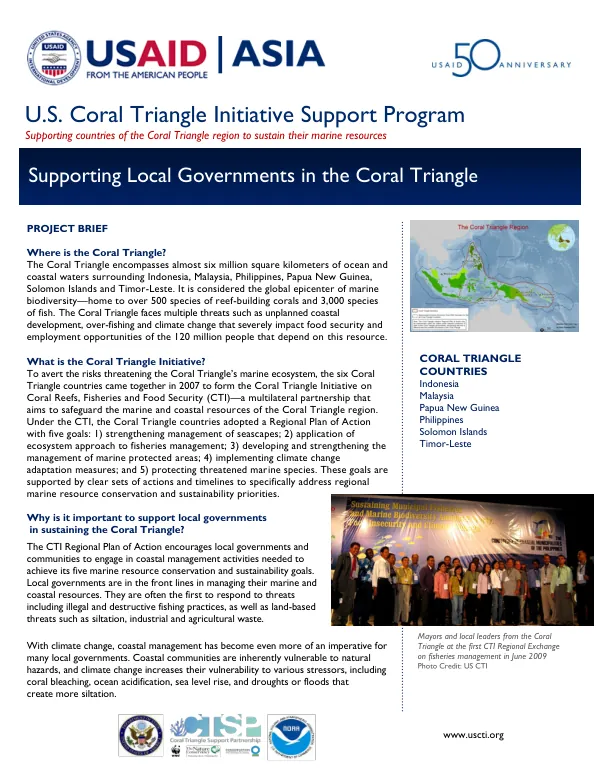
The Coral Triangle Initiative on Coral Reefs, Fisheries and Food Security (CTI) is a multilateral partnership among six countries: Indonesia, Malaysia, Philippines, Papua New Guinea, Solomon Islands, and Timor-Leste.
2012 · 2 pages
Sign in to readA free account is required to download.
Abstract
The initiative aims to safeguard the marine and coastal resources of the Coral Triangle region, which is considered the global epicenter of marine biodiversity. The Coral Triangle encompasses almost six million square kilometers of ocean and coastal waters, home to over 500 species of reef-building corals and 3,000 species of fish. The CTI Regional Plan of Action, adopted by the six Coral Triangle countries in 2007, sets out five goals to address regional marine resource conservation and sustainability priorities. These goals include strengthening management of seascapes, application of an ecosystem approach to fisheries management, developing and strengthening the management of marine protected areas, implementing climate change adaptation measures, and protecting threatened marine species. The plan is supported by clear sets of actions and timelines to address regional marine resource conservation and sustainability priorities. Local governments play a crucial role in managing their marine and coastal resources, as they are often the first to respond to threats such as illegal and destructive fishing practices, as well as land-based threats such as siltation and industrial and agricultural waste. With climate change, coastal management has become even more imperative for many local governments, as coastal communities are inherently vulnerable to natural hazards and climate change increases their vulnerability to various stressors. The CTI Local Governance Network (CTI-LGN) was established to support local government leaders in the Coral Triangle region. The network facilitates learning exchanges and provides on-the-ground support in establishing marine protected areas and implementing climate change adaptation plans. The US Government, through the US CTI Support Program, is supporting local governments by enhancing local leaders' capacity, providing on-the-ground support, and facilitating learning exchanges through the CTI-LGN. In 2011, local government leaders from the six Coral Triangle countries signed a joint communiqué, agreeing to collaborate, share information, experience, and expertise, and advocate policies to achieve the goals of the CTI-CFF. The communiqué sets out a vision for local governments to be resourced, innovative, informed, and effective in collaborating, sharing information, experience, and expertise, and advocating policies to achieve the goals of the CTI-CFF by 2016. The local governments also agreed to undertake several actions, including meeting regularly in a CTI-CFF Mayors Round Table, promoting awareness about the CTI-CFF, identifying a CTI-CFF local government focal point in each country, and exploring opportunities for regional dialogue on best practices and collaboration of expertise among member countries.
Related documents