TETRA TECH ARD, INC.
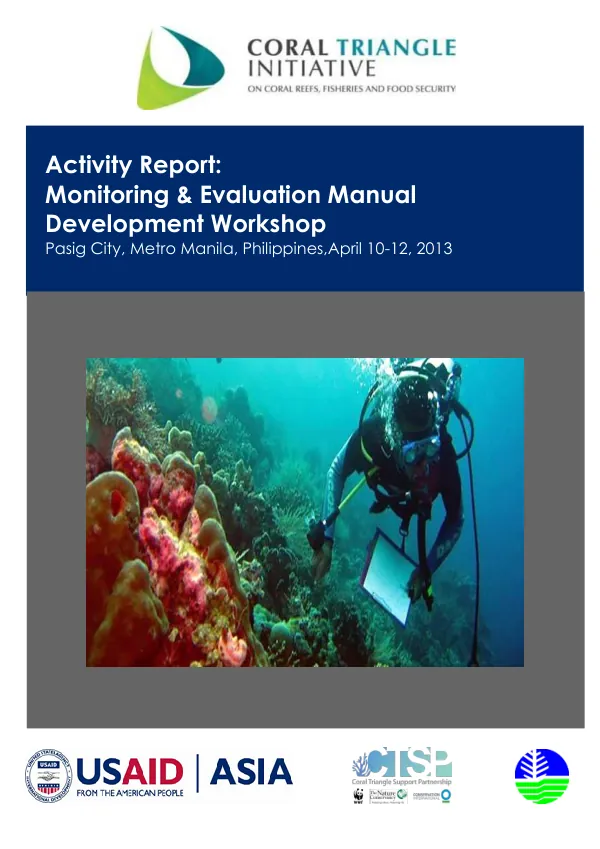
Activity Report: Monitoring & Evaluation Manual Development Workshop
The Coral Triangle Initiative on Coral Reefs, Fisheries and Food Security (CTI-CFF) is a regional program composed of six member countries: Indonesia, Malaysia, Papua New Guinea (PNG), Philippines, Solomon Islands, and Timor-Leste.
2013 · 83 pages
Sign in to readA free account is required to download.
Abstract
The CTI-CFF aims to achieve five overall goals, as outlined in the 2010-2020 Regional Plan of Action (RPOA). These goals include priority seascapes, ecosystem approach to managing fisheries and other marine resources (EAFM), marine protected areas (MPAs), climate change adaptation (CCA), and threatened species. A monitoring and evaluation working group (MEWG) has been tasked with developing indicators for these goals. The MEWG has been coordinating with the five thematic technical working groups (TWGs) responsible for the corresponding RPOA goals to develop, revise, and refine the indicators and define an M&E system. The draft indicators and M&E system presented at the Senior Officials Meeting (SOM8) in November 2012 served as the main inputs to the workshop. The workshop, hosted by the Government of the Philippines, aimed to develop an operations manual for regional monitoring, evaluation, and reporting of progress toward the goals of the RPOA. The specific objectives of the workshop included identifying the monitoring and evaluation tasks by country and by thematic TWG, identifying and nominating responsible parties for each task, estimating the cost of the M&E tasks, and evaluating and assessing current capacities and resources to implement the M&E system in each country. The MEWG has been coordinating with the five thematic TWGs since 2008 to develop the indicators and define the M&E system. The draft indicators and M&E system presented at SOM8 in November 2012 were endorsed by the CT6 for adoption, with provisions for modification of indicators by respective thematic TWGs for continuing improvement. The workshop brought together representatives from the six member countries to discuss and finalize the M&E system and indicators. The participants included representatives from the Department of Environment and Natural Resources (DENR), the Food and Agriculture Organization (FAO), the International Union for Conservation of Nature (IUCN), and other organizations. The workshop was facilitated by the US Coral Triangle Initiative Support Program (USCTI) and the German Society for International Cooperation (GIZ). The M&E system and indicators developed during the workshop will be used to monitor and evaluate progress toward the goals of the RPOA. The system includes mechanisms for data collection, storage, retrieval, processing, analysis, and reporting. The indicators and M&E system will be used to track progress and identify areas for improvement, and to inform decision-making at the national and regional levels. The workshop also identified responsible parties for each task and estimated the cost of the M&E tasks. The participants evaluated and assessed current capacities and resources to implement the M&E system in each country. The workshop outcomes will be used to inform the development of the M&E System Operations Manual and to guide the implementation of the M&E system in each country. The development of the M&E system and indicators is a critical component of the CTI-CFF's efforts to achieve its goals. The system will provide a framework for monitoring and evaluating progress toward the goals of the RPOA, and will inform decision-making at the national and regional levels. The workshop outcomes will be used to guide the implementation of the M&E system in each country and to ensure that the system is effective in achieving the goals of the CTI-CFF.