USAID DEC
Cost-benefit analysis of outsourcing cleaning services at Mahalapye hospital, Botswana
Sign inABT ASSOCIATES
Cost-benefit analysis of outsourcing cleaning services at Mahalapye hospital, Botswana
Botswana has implemented a national privatization strategy to diversify its economy, which includes outsourcing nonclinical services at public hospitals.
2016 · 11 pages
Sign in to readA free account is required to download.
Abstract
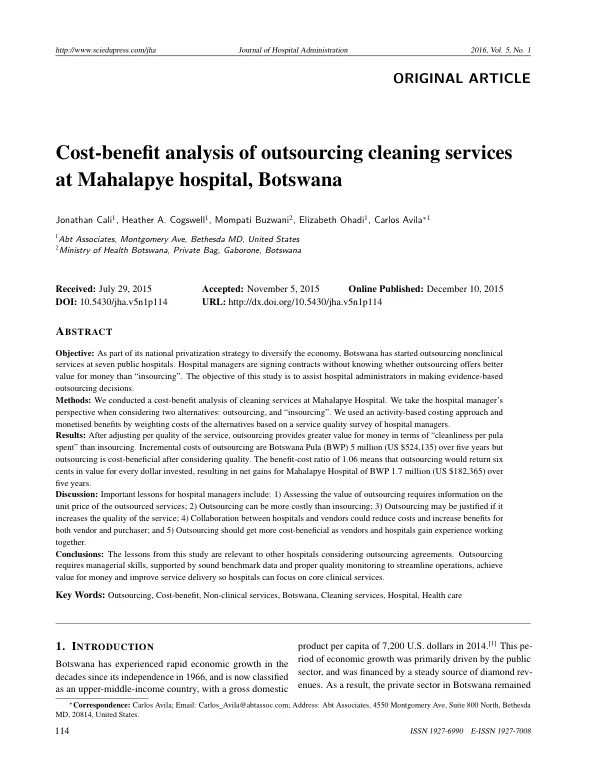
As part of this strategy, the Ministry of Health (MoH) has started outsourcing nonclinical services, including laundry, catering services, cleaning, porter and grounds-maintenance services, and security services, at seven hospitals around the country. The most frequently-cited reasons for outsourcing include improving service delivery performance, improving quality of care, reducing costs, and increasing efficiency. A cost-benefit analysis of outsourcing cleaning services at Mahalapye Hospital was conducted to provide information to hospital managers on the cost and quality of outsourcing nonclinical services. The analysis took the hospital manager's perspective when calculating costs and benefits of outsourcing. The horizon for analysis was five years, which allowed the study to capture benefits from outsourcing that may accrue in the medium term, such as improvements in the quality of cleaning. The analysis found that outsourcing cleaning services at Mahalapye Hospital provides greater value for money in terms of "cleanliness per pula spent" than insourcing. Incremental costs of outsourcing were Botswana Pula (BWP) 5 million (US $524,135) over five years, but outsourcing was cost-beneficial after considering quality. The benefit-cost ratio of 1.06 means that outsourcing would return six cents in value for every dollar invested, resulting in net gains for Mahalapye Hospital of BWP 1.7 million (US $182,365) over five years. The study highlights important lessons for hospital administrators in navigating the outsourcing process. These include assessing the value of outsourcing, which requires information on the unit price of the outsourced services; outsourcing can be more costly than insourcing; outsourcing may be justified if it increases the quality of the service; collaboration between hospitals and vendors could reduce costs and increase benefits for both vendor and purchaser; and outsourcing should become more cost-beneficial as vendors and hospitals gain experience working together. Mahalapye Hospital is a modern 260-bed public district hospital located in the Central District of Botswana. It has an annual operating budget of approximately Botswana pula (BWP) 24 million (US$ 2.6 million) and a floor space of 28,461 square meters. The hospital began outsourcing security services in 2011 and laundry and cleaning services in April and May of 2014, respectively. The analysis of cleaning services was chosen because the data available on the costs and production units of cleaning were more complete than data on other outsourced services. The study used an activity-based costing approach and monetized benefits by weighting costs of the alternatives based on a service quality survey of hospital managers. The analysis discounted both the costs and benefits of outsourcing to account for the opportunity costs of money. A 10 percent discount rate was selected based on a review that found that the World Bank and African Development Bank use a discount rate of 10-12 percent for cost-benefit analyses of projects implemented in their member countries.
Related documents
Documents in this collection
 2015
2015USAID DEC
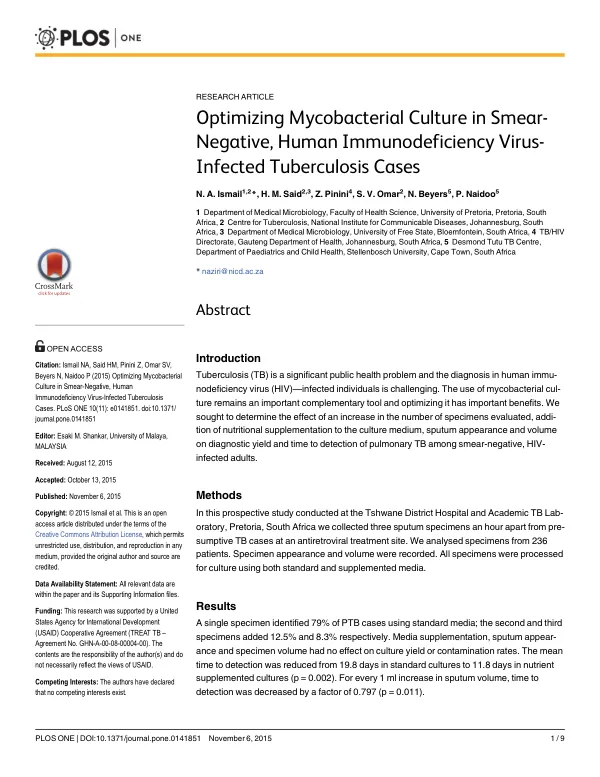
Optimizing Mycobacterial Culture in Smear-Negative, Human Immunodeficiency Virus-Infected Tuberculosis Cases
Open record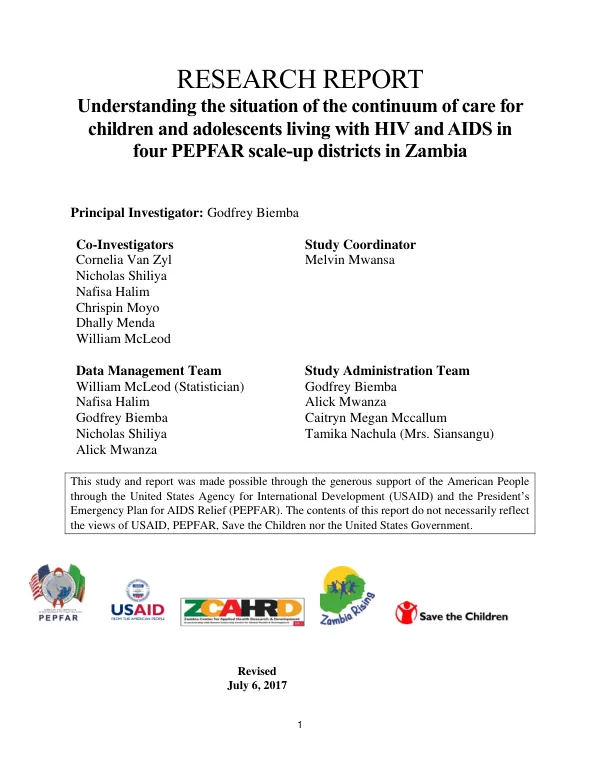 2017
2017USAID DEC
Understanding the situation of the continuum of care for children and adolescents living with HIV and AIDS in four PEPFAR scale-up districts in Zambia
Open record