KNCV TUBERCULOSIS FOUNDATION
Final Report: TB CARE I – Botswana
TB CARE I in Botswana was a four-year project funded by the United States Agency for International Development (USAID) with a total budget of $US 1,363,667.
2014 · 26 pages
Sign in to readA free account is required to download.
Abstract
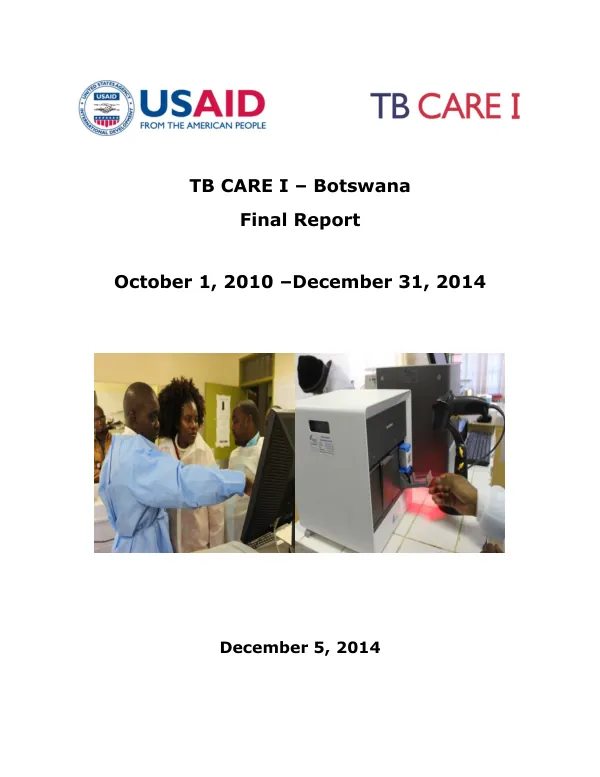
The project focused on providing technical support in various areas of TB control, including laboratory strengthening, programmatic management of drug-resistant TB, and community TB care expansion. The Botswana country office was comprised of two staff members: one Senior Technical Advisor (STA) based at the National Tuberculosis Control Program (BNTP) and one Chief Medical Laboratory Technician (CMLT) based at the National Tuberculosis Reference Laboratory (NTRL). International TB CARE I consultants provided supervision and technical support through backstopping, country visits, and facilitating the training of recruited staff. TB CARE I provided comprehensive technical support to the Ministry of Health (NTP & NTRL) and achieved several targets, including the expansion of community TB care, Public-Private Mix (PPM) engagement, TB control in the mining sector, NTRL accreditation, GeneXpert roll-out, routine audiology services, and NSP development. Community TB care has been expanded in the country, with uptake improving from 45% in 2011 to 65% in 2013. A national evaluation of community TB care implementation in Botswana has been completed. The sustained scale-up of community TB care through increased engagement of civil society will empower TB patients and affected communities to participate in TB control. TB CARE I also supported the development of a national Public-Private Mix (PPM) framework for engagement of the private sector in TB control. Two hundred seventy-eight (278) health care workers from the private sector were trained on TB control using the guideline. About 20 private health care facilities are currently engaged in the management of TB, with over 70 TB patients managed in the private sector under the PPM scheme. The National Tuberculosis Reference Laboratory (NTRL) has been successfully accredited and received its accreditation to ISO 15189 through the South Africa Accreditation Systems (SANAS) and continued to retain its status as an ISO 15189 accredited laboratory. The same laboratory was selected as a SADC Regional Supranational Reference Laboratory. GeneXpert machines have been rolled out to 34 health facilities, covering all 28 health districts in the country. TB CARE I contributed to the development of a comprehensive roll-out plan for GeneXpert implementation and supported training of staff, updating of GeneXpert algorithms, and conducting sites assessment. Routine audiology services have been established in all five MDR-TB treatment initiation sites in Botswana as a result of TB CARE I technical guidance. As a result, routine audiology services are now provided in all of the MDR-TB treatment initiation sites linked to the national Center of Excellence in Princes Marina Hospital (PMH) in Gaborone. TB CARE I provided technical assistance to develop a robust national strategic plan for TB control (2013 – 2017) through regular consultative meetings with stakeholders, extensive review of recommendations from existing reviews, assessments, and mission reports. TB CARE I also supported development of the addendum to the current TB Strategic Plan 2013 – 2017 in-line with the WHO post-2015 End TB strategic plan and the Global Fund New Funding Model requirements. TB CARE I has been closely involved in Global Fund (GFATM) support and concept note development in Botswana, including Round 5 Global Fund, Transitional Funding Mechanism (TFM), development of single TB/HIV concept note under the new funding model. TB CARE I also supported the development of a Prevalence Survey protocol for Botswana. Overall, the national response to TB is on track, though still much needs to be done to close the gap to set national targets. Botswana has an unacceptably high burden of TB in comparison to global incidence.
Related documents