USAID DEC
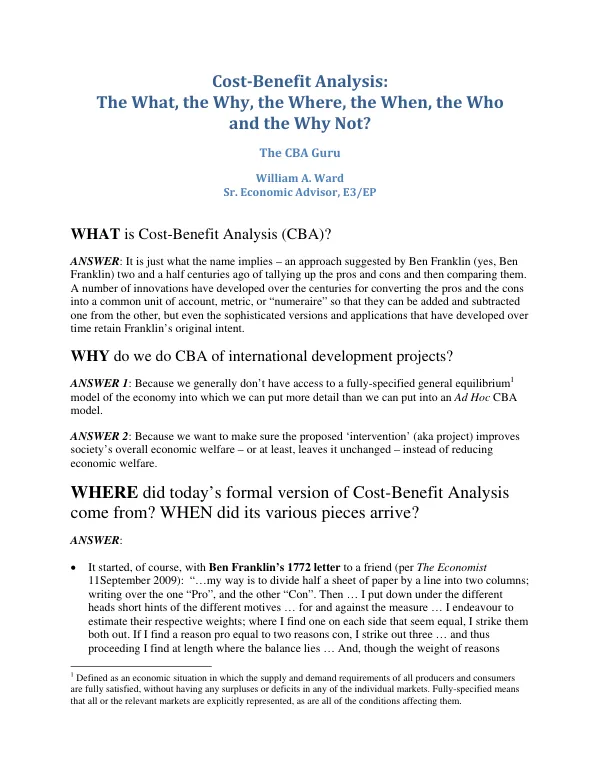
Cost-Benefit Analysis: The What, the Why, the Where, the When, the Who and the Why Not?
Sign inUSAID
Cost-Benefit Analysis: The What, the Why, the Where, the When, the Who and the Why Not?
Cost-Benefit Analysis (CBA) is an approach that originated with Ben Franklin in 1772, where he suggested tallying up the pros and cons and comparing them.
2014 · 4 pages
Sign in to readA free account is required to download.
Abstract
This approach has evolved over the centuries, with various innovations for converting the pros and cons into a common unit of account, metric, or "numeraire" so that they can be added and subtracted one from the other. The primary reason for conducting CBA of international development projects is that it allows for the evaluation of proposed interventions to ensure they improve society's overall economic welfare, rather than reducing it. This is particularly important when general equilibrium models of the economy are not fully specified, making it difficult to accurately assess the impact of projects. The formal version of CBA has its roots in the 19th century, with the French engineer Jules Dupuit suggesting the use of consumers' surplus to value the benefits of transportation projects in 1848. This distinction between financial analysis (market price times quantity) and economic analysis (consumers' surplus, later joined by producers' surplus) laid the foundation for the development of CBA. In the post-World War II period, planning models were hypothesized, but never developed, to identify and plan development interventions. The Simplex Method for solving linear programming problems, presented by George Danzig in 1947, provided a framework for deriving shadow prices, which would have allowed planners to judge the contributions of incremental changes to the production system. However, the computational capacity to solve such models did not exist at the time. In the 1960s, practical methods of shadow pricing emerged, with Ian Little and Jim Mirrlees developing the Trade Policy Approach (TPA) to CBA, and Al Harberger developing the Public Finance Approach (PFA). The TPA was primarily focused on international development projects, while the PFA focused on public expenditure analysis. The PFA eventually replaced the TPA in international development project applications, as the focus of international development finance shifted from trade policy to financing projects in the social sectors and dealing with organizational and institutional change. Economic development projects are typically prepared by sector technicians (engineers, agronomists, etc.) and/or sector-specialized economists (agricultural economists, etc.). These professionals use CBA to evaluate the costs and benefits of proposed projects, taking into account the specific context and goals of the project. The Public Finance Approach, developed by Al Harberger, is now the method taught in E3/EP training programs and is widely used in international development project applications.
Related documents