DEPARTMENT OF HEALTH
Cost-effectiveness of early identification of HIV infection
The early identification of HIV infection and subsequent treatment with antiretroviral therapy (ART) is widely recognized to improve long-term outcomes for patients and prevent HIV transmission.
2017 · 2 pages
Sign in to readA free account is required to download.
Abstract
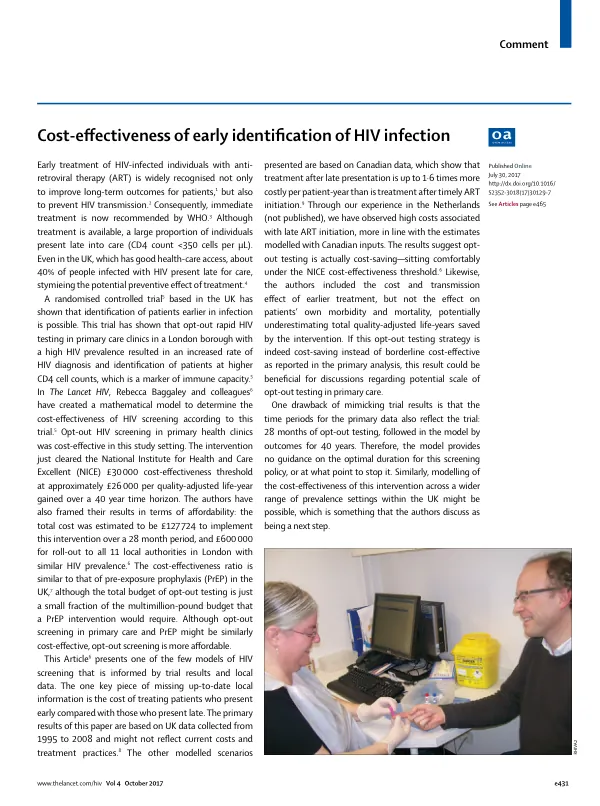
Immediate treatment is now recommended by the World Health Organization (WHO) due to its proven benefits. However, a significant proportion of individuals present late into care, with a CD4 count below 350 cells per microliter, which hinders the potential preventive effect of treatment. A randomized controlled trial conducted in the UK demonstrated that opt-out rapid HIV testing in primary care clinics can lead to an increased rate of HIV diagnosis and identification of patients at higher CD4 cell counts. This trial provided the basis for a mathematical model created by Rebecca Baggaley and colleagues to determine the cost-effectiveness of HIV screening. The model found that opt-out HIV screening in primary health clinics was cost-effective, with an estimated cost-effectiveness ratio of approximately £26,000 per quality-adjusted life-year gained over a 40-year time horizon. The study's results suggest that opt-out testing is a cost-effective strategy for identifying HIV-infected individuals early in the infection process. The intervention cleared the National Institute for Health and Care Excellence (NICE) £30,000 cost-effectiveness threshold. The total cost of implementing this intervention over a 28-month period was estimated to be £127,724, and £600,000 for roll-out to all 11 local authorities in London with similar HIV prevalence. The cost-effectiveness ratio is comparable to that of pre-exposure prophylaxis (PrEP) in the UK, although the total budget for opt-out testing is significantly lower. The study's findings provide good evidence for opt-out HIV testing in high-prevalence areas. The results of the cost-effectiveness analysis can be comfortably generalized to settings with similar HIV epidemics and healthcare costs. The study's authors suggest that the intervention is likely to be more cost-effective in high-prevalence settings, where testing yield will be higher. For instance, a study in South Africa produced incremental cost-effectiveness ratios of various testing interventions ranging between $614 and $1375 per life-year saved. The study's results have implications for public health policy and practice. The early identification and treatment of HIV-infected individuals can lead to improved health outcomes and reduced transmission rates. The cost-effectiveness of opt-out HIV testing in primary care clinics makes it a viable strategy for identifying and treating HIV-infected individuals early in the infection process. The study's findings can inform policy decisions and guide the implementation of HIV screening programs in high-prevalence settings.