ARIZONA STATE UNIVERSITY
Countering Energy Cybersecurity Threats
The Countering Energy Cybersecurity Threats (CECT) program aims to strengthen local partners' ability to counter cyberattacks on critical energy infrastructure.
2022 · 2 pages
Sign in to readA free account is required to download.
Abstract
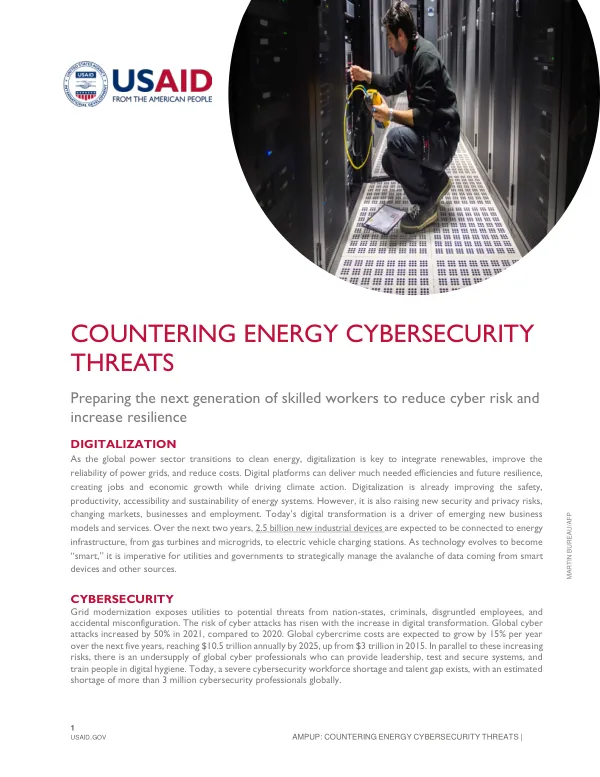
This initiative focuses on building skills to detect, protect, respond, and recover from cyberattacks. The program introduces USAID partners to U.S. cyber standards, policies, and practices, while also providing insight for U.S. actors into the cyber threats and needs of USAID partner countries. Digitalization is a key driver of emerging new business models and services in the energy sector. The increasing number of connected devices, from gas turbines and microgrids to electric vehicle charging stations, poses significant cybersecurity risks. The risk of cyber attacks has risen with the increase in digital transformation, with global cyber attacks increasing by 50% in 2021 compared to 2020. The global cybercrime costs are expected to grow by 15% per year over the next five years, reaching $10.5 trillion annually by 2025. The CECT program takes a holistic approach to cyber education for energy professionals, with no technical prerequisite knowledge required. Participants gain an understanding of the relationship between information and operational technologies and receive hands-on experiences to illustrate technical challenges, risks, and vulnerabilities common in energy system hardware and business services. The program aims to minimize the knowledge gap and increase the talent pool in cybersecurity around the world. The CECT program utilizes the vast experiences and knowledge of a diverse team, including energy sector experts from around the world. The project offers an unparalleled network of utility and energy sector expertise to support the global energy transition. The goal of the program is to dramatically reduce risk while increasing participants' ability to operate power systems in a more secure manner. Successful participants earn Institute of Electrical and Electronics Engineers (IEEE) certification, the world's largest technical professional organization. A select group of participants is eligible for Global Information Assurance Certification (GIAC), one of the most challenging and meaningful credentials in cybersecurity. The CECT program partners with the United States Energy Association (USEA), Arizona State University (ASU), SANS Institute (SANS), and Global Information Assurance Certification (GIAC). These partners bring expertise in energy security, renewable energy, cybersecurity training, and certifications to support the program's goals. The program is led by USAID, with Kristen Madler and Jamila Amodeo serving as key contacts.